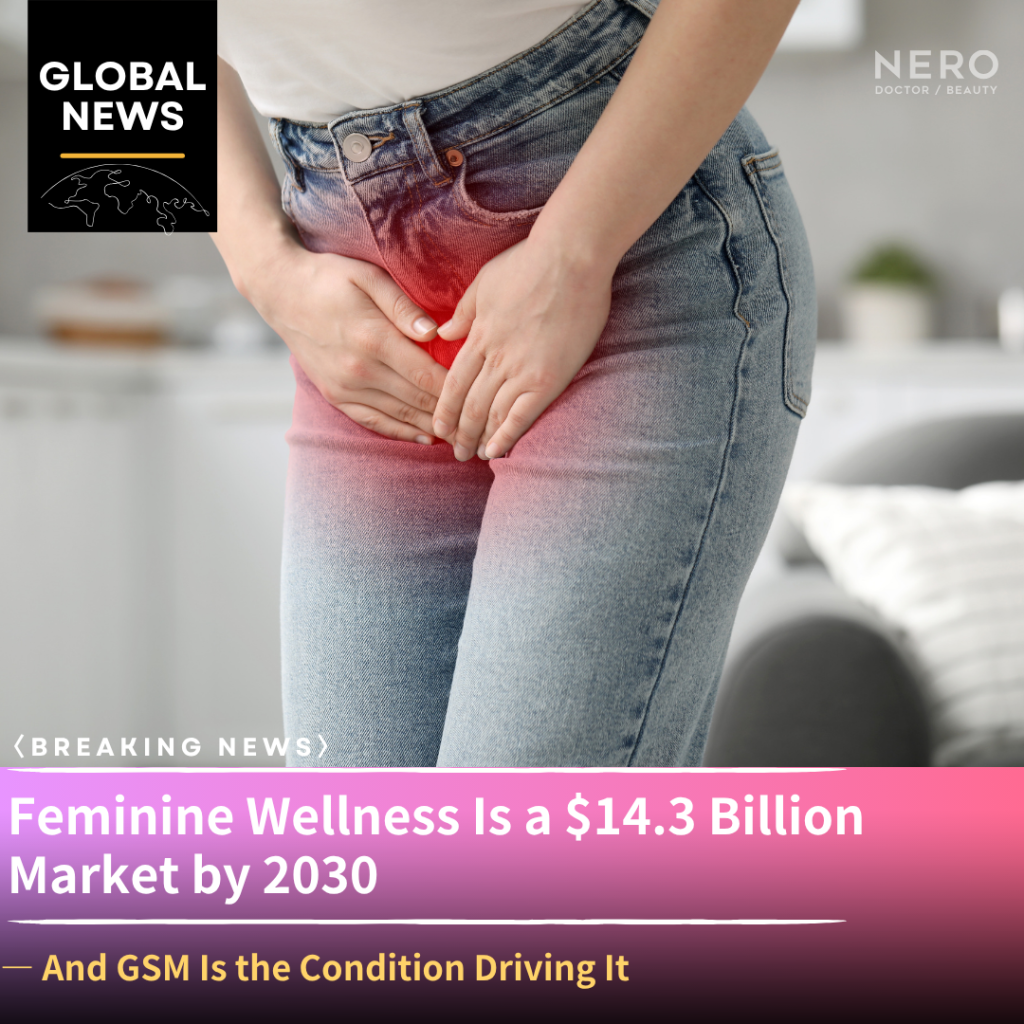
📌 Key Takeaways
- The global feminine wellness market was valued at $3.6 billion in 2023
and is projected to reach $14.3 billion by 2030 (Grand View Research, 2024). - Genitourinary Syndrome of Menopause (GSM) — affecting an estimated 50% of postmenopausal women —
is a primary driver of this growth, as awareness and non-surgical treatment options expand. - The American College of Obstetricians and Gynecologists (ACOG) warns that
sufficient evidence supporting the safety and efficacy of many vaginal rejuvenation procedures does not yet exist. - In Japan, this category remains largely unaddressed across gynecology, urology, and aesthetic clinics —
creating a significant information gap for patients.
“I’ve had stress incontinence since giving birth.”
“Intercourse became painful after menopause.”
“The dryness is constant and uncomfortable.”
These are concerns that millions of women hesitate to raise —
with their gynecologist, their urologist, or their aesthetic clinic.
For decades, they were dismissed as an inevitable part of aging.
In 2026, medicine increasingly classifies them as treatable conditions.


INDEX
What Is Genitourinary Syndrome of Menopause (GSM)?
In 2014, the North American Menopause Society formally defined Genitourinary Syndrome of Menopause (GSM) —
a term encompassing vaginal atrophy, dyspareunia (painful intercourse), and urinary symptoms
previously treated as separate, unrelated complaints.
GSM is caused by declining estrogen levels, which cause the tissues of the vagina,
vulva, bladder, and urethra to thin, dry out, and lose elasticity.
Symptoms include vaginal dryness, painful intercourse, vulvar itching,
urinary incontinence, urinary urgency, and increased risk of vaginal infections.
An estimated 50% of postmenopausal women experience GSM symptoms —
yet only a fraction seek or receive treatment.
The most common reasons: “I didn’t think it was something I could discuss,”
“I assumed it was just aging,” or simply, “I didn’t know it had a name.”
Why the Market Is Expanding: Three Structural Drivers
Driver 1: The Normalization of Intimate Health Conversations
Social media, podcasts, and high-profile public disclosures have moved topics like
menopause, vaginal health, and sexual wellness into mainstream health discourse.
The cultural shift — from “just accept it” to “this can be treated” —
is accelerating consumer demand globally.
Driver 2: Expansion of Non-Surgical Treatment Options
CO2 laser, radiofrequency (RF), PRP, topical hormone therapy, and hyaluronic acid injections
have expanded the treatment landscape beyond surgery.
The availability of minimally invasive options is a key factor
in lowering the barrier to seeking care.
Driver 3: Rising Awareness of GSM and Postpartum Pelvic Floor Conditions
Growing recognition of childbirth-related pelvic floor dysfunction —
including incontinence, dyspareunia, and pelvic organ prolapse —
is generating demand for postpartum care.
Meanwhile, health-conscious women in their 40s and 50s are increasingly seeking
preventive care before symptoms become severe.
ACOG’s Official Warning: What Patients Must Verify
⚠️ ACOG Official Position
The American College of Obstetricians and Gynecologists (ACOG) has officially stated
that “there is insufficient evidence to support the safety and efficacy”
of labiaplasty and other female genital cosmetic surgery procedures,
including vaginal rejuvenation (ACOG, 2026).
A critical practical concern: many laser and RF devices used for intravaginal GSM treatment
are not FDA-approved for that specific indication,
yet are widely offered in clinical settings.
Before undergoing any procedure, patients should verify:
the device’s regulatory approval status,
the provider’s specialty credentials,
the known risk profile, and the quality of available evidence.
Japan’s Information Gap: The Category No One Owns
In Japan, vaginal health, menopausal sexual wellness, and postpartum pelvic floor care
occupy an ambiguous space — not clearly owned by gynecology, urology, or aesthetic medicine.
There is no established “front door” for patients seeking help.
Yet the patients exist.
“I don’t know where to go.”
“I was afraid of being judged for asking.”
Closing this information asymmetry is a core part of what NERO does.

The term “feminine care” has yet to fully enter mainstream conversation in Japan.
But as the market trajectory from $3.6 billion to $14.3 billion makes clear,
pelvic floor health, vaginal wellness, and sexual wellbeing
have already become central themes in global aesthetic and preventive medicine.
NERO is committed to covering this category accurately, neutrally, and from the patient’s perspective — ahead of the curve.
“There’s nothing I can do”
may simply mean
“I didn’t know there was an option.”
Knowledge creates choice.
Summary
- The feminine wellness market is projected to grow from $3.6 billion (2023) to $14.3 billion by 2030,
driven by GSM awareness, non-surgical treatment expansion, and postpartum care demand. - GSM affects an estimated 50% of postmenopausal women
but remains undertreated due to stigma, lack of awareness, and unclear care pathways. - ACOG warns that sufficient evidence supporting the safety and efficacy of many vaginal rejuvenation procedures does not yet exist.
Patients should verify device approval status, provider credentials, and evidence quality before proceeding. - In Japan, this category lacks a clear clinical home across specialties —
creating an information gap that NERO is working to address.
It describes a cluster of symptoms caused by declining estrogen after menopause,
including vaginal dryness, painful intercourse, urinary incontinence, and increased infection risk.
An estimated 50% of postmenopausal women are affected.
platelet-rich plasma (PRP) therapy, topical estrogen or hormone therapy,
and hyaluronic acid injections.
However, many devices used in clinical practice are not FDA-approved for GSM specifically.
Patients should confirm regulatory status and provider qualifications before treatment.
that there is currently insufficient clinical evidence to support the safety and efficacy
of vaginal rejuvenation and female genital cosmetic surgery procedures.
This does not mean all treatments are ineffective —
but it does mean patients should approach the category with informed caution
and seek providers with verified specialty credentials.
Sources
Grand View Research, “Vaginal Rejuvenation Market Size & Share Report, 2030,” 2024 /
American Society of Plastic Surgeons (ASPS), “Plastic Surgery Statistics Report 2024,” 2025 /
Skinsational, “Vaginal Rejuvenation in 2026: What Actually Works and What Doesn’t?,” February 2026 /
American College of Obstetricians and Gynecologists (ACOG), “Vaginal Rejuvenation, Labiaplasty, and Other Female Genital Cosmetic Surgery,” ACOG Official Position, 2026 /
AUA/SUFU/AUGS, “Genitourinary Syndrome of Menopause Guideline 2025” /
North American Menopause Society, “Genitourinary Syndrome of Menopause,” Patient Guide