📌 Key Takeaways
- Multiple Japanese aesthetic physicians publicly questioned on X (formerly Twitter) whether Korean doctors can legally conduct consultations and issue treatment estimates in Japan —
the legal answer is: depending on what occurs, these events may constitute unlicensed medical practice under Article 17 of Japan’s Medical Practitioners’ Act. - Practicing medicine in Japan — including diagnosis, treatment planning, and prescribing — requires a Japanese medical license.
Korean licenses carry no legal standing in Japan.
Permanent makeup (tattoo-style pigment injection) performed by visiting Korean practitioners has been explicitly classified as a medical act by the MHLW since 2001. - MHLW notifications issued in August and December 2025 escalated enforcement from administrative guidance to active coordination with law enforcement.
Before attending any consultation event, patients should understand the risks NERO outlines below.
On the evening of June 9, 2026, Japan’s aesthetic medicine community on X erupted over a deceptively simple question.
A physician running clinics in Tokyo and Osaka posted: “I’m totally ignorant here — but are Korean medical licenses actually valid for performing medical acts in Japan?”
They followed up: “Issuing a diagnosis, or even a price estimate — that feels like practicing medicine to me.”
The thread drew rapid responses from influencer physicians and industry insiders.
“These Japan consultation events have always been in a gray zone, right? They’re actually not allowed?”
“Korean practitioners coming to Japan to do permanent makeup — that’s also illegal.”
How much of this is legally accurate?
NERO breaks it down using primary sources.


INDEX
- Background: What Are “Korean Beauty Consultation Events” in Japan?
- Legal Analysis ①: Is a Korean Medical License Valid in Japan?
- Legal Analysis ②: Does Issuing a Diagnosis or Price Estimate Constitute Medical Practice?
- Legal Analysis ③: What About Visiting Korean Practitioners Performing Permanent Makeup in Japan?
- Why Are Japanese Aesthetic Physicians Speaking Out Now?
- What Patients Should Know Before Attending
- Summary
- Frequently Asked Questions
Background: What Are “Korean Beauty Consultation Events” in Japan?
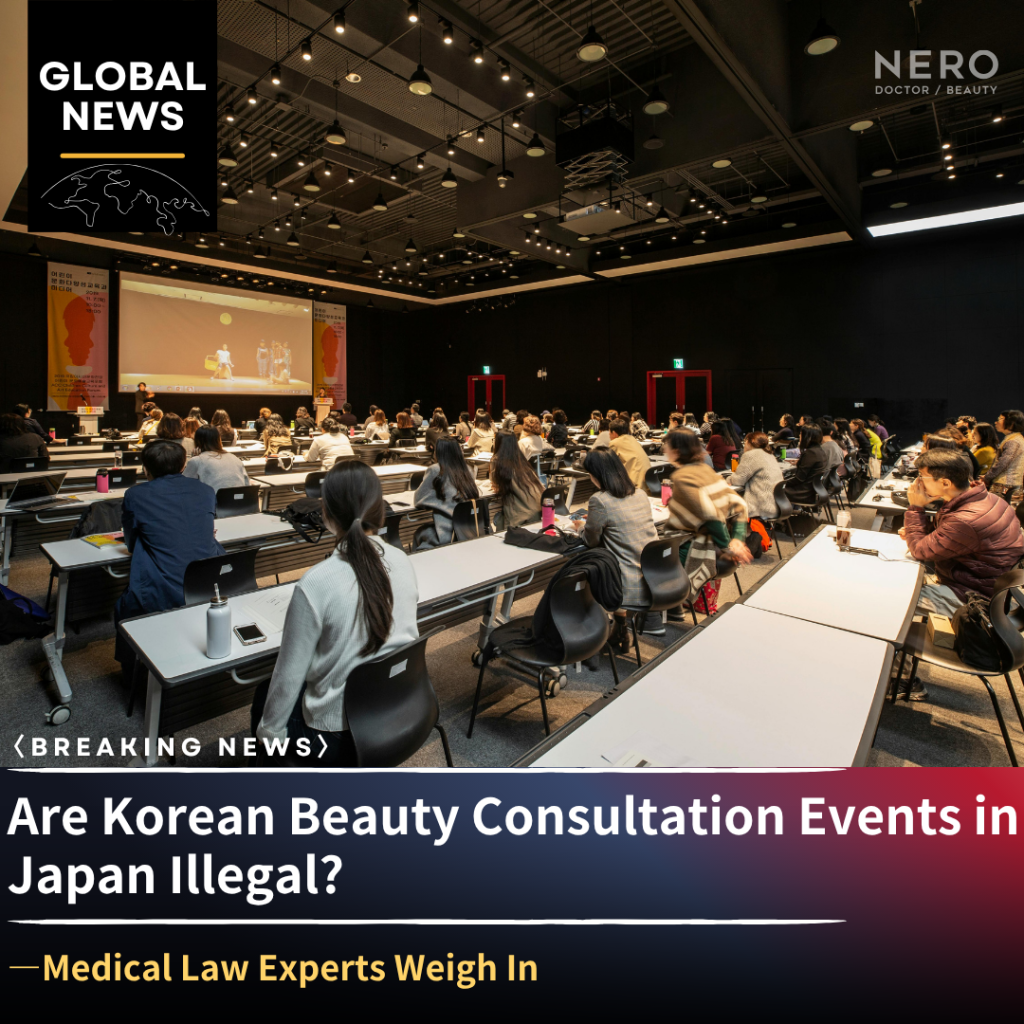
Physicians and counselors from Korean cosmetic surgery and aesthetic dermatology clinics travel to Japan
and hold counseling sessions for Japanese patients at hotel conference rooms, dedicated venues,
or spaces within affiliated Japanese clinics.
Most events are free to attend and include interpreters.
Some promotional materials describe them as offering “detailed consultations including case reviews and individualized price estimates — equivalent to visiting the clinic in Korea.”
One major platform, Gangnam Unni (カンナムオンニ), held its first Japan consultation event in November 2022
and has since reached a cumulative attendance of approximately 3,000 participants.
As of 2026, affiliated clinics such as WOM CLINIC GINZA continue to host regular Korean clinic consultation events in Japan.
Note: NERO has not directly attended or investigated any specific consultation event.
This article does not target any specific event, clinic, or platform.
It is intended solely to explain the legal framework under Japan’s Medical Practitioners’ Act and MHLW notifications,
so readers can make informed decisions.
Legal Analysis ①: Is a Korean Medical License Valid in Japan?
❌ Conclusion: Not valid in any capacity
Article 17 of Japan’s Medical Practitioners’ Act states: “No person other than a physician shall practice medicine.”
Performing any medical act without a Japanese license is explicitly prohibited.
Practicing medicine in Japan — including examination, diagnosis, prescribing, and surgery — requires a Japanese medical license.
Foreign medical licenses are not recognized under Japanese law,
except under a narrow special provision allowing clinical training at designated university hospitals for educational and research purposes only.
That exception does not apply to aesthetic medicine consultation events held at hotels or event venues.
Legal Analysis ②: Does Issuing a Diagnosis or Price Estimate Constitute Medical Practice?
“This procedure is right for you” = Diagnosis = Fully constitutes medical practice
Statements such as “You need this surgery” or “We’ll inject X cc here” represent medical judgment (diagnosis)
that only a licensed physician may make.
If made by someone without a Japanese medical license,
this constitutes a violation of Article 17 (unlicensed medical practice).
The legal risk of issuing individualized price estimates
Presenting a general price menu is administrative.
But stating “Given your degree of sagging, you need 10 PDO threads and liposuction — total cost: ¥XX0,000”
is effectively determining a treatment plan (medical practice) and then soliciting a contract.
This may conflict with MHLW’s stated concerns about
“unlicensed counselors conducting patient assessments”
and “counselor-led treatment planning.”
The legal loophole that has been used
Operators have long framed these events as
“pre-consultation for treatment to be performed in Korea — not a clinical encounter.”
However, if a person without a Japanese medical license
provides specific procedure recommendations based on an individual’s anatomy at such an event,
that activity carries a very high risk of crossing into unlicensed medical practice
as prohibited under Article 17 — regardless of how it is labeled.
Legal Analysis ③: What About Visiting Korean Practitioners Performing Permanent Makeup in Japan?
❌ This is not a gray area — the MHLW has explicitly classified it as a violation
In a November 2001 notification (MHLW Medical Policy Notice No. 105),
the Ministry of Health, Labour and Welfare first clarified that
needle-based pigment injection — including permanent makeup — constitutes a “medical act”
that cannot be performed by anyone without a medical license.
The comprehensive August 15, 2025 notification (MHLW Medical Policy Notice 0815 No. 21)
explicitly instructed public health centers that
“in egregious cases, referral to or formal complaint with police and investigative authorities should be pursued.”
The era of “you’ll just get a warning” is over.
Korean practitioners who travel to Japan and perform permanent makeup in rented apartments or salons
have been arrested and referred to prosecutors under the Medical Practitioners’ Act.
Why Are Japanese Aesthetic Physicians Speaking Out Now?
📅 Regulatory Escalation Timeline: 2025–2026
MHLW issues notification to prefectural governments explicitly listing suspected illegal practices,
including “treatment planning by unlicensed staff” and “inadequate diagnosis conducted only via email or chat.”
Public health centers granted strengthened authority for on-site inspections.
MHLW explicitly names hair removal, permanent makeup, and HIFU as medical acts
that violate Article 17 when performed by unlicensed individuals.
Japanese aesthetic physicians publicly raise the legal status of Korean consultation events on X.
The thread accumulates over 9,000 impressions and spreads widely within the industry.
① Rapid expansion of Korean clinic groups into Japan
Korean clinic networks have established direct and affiliated operations in Japan,
conducting routine patient acquisition and counseling domestically.
The framing of “pre-consultation for overseas treatment” is becoming increasingly difficult to sustain.
② Fair competition concerns
Japanese physicians who operate in full compliance with domestic law
are increasingly vocal that “schemes that circumvent legal requirements to acquire patients cannot be ignored.”
③ Regulatory tightening has made “looking the other way” untenable
A 2024 MHLW study group on appropriate aesthetic medicine practices found that
in 20.5% of surveyed clinics, counselors were conducting patient examinations;
in 13.8%, counselors were performing procedures.
With public health centers now empowered to conduct on-site inspections,
“everyone does it” is no longer a viable defense.
What Patients Should Know Before Attending
Before attending a Korean beauty consultation event in Japan,
patients should verify three things:
- Who is making the diagnosis and treatment recommendation?
Is a physician with a Japanese medical license present and conducting the assessment?
If only a counselor or Korean physician is saying “you need this procedure,”
ask for the legal basis of that recommendation. - Where will the actual procedure take place?
Consultation events should be for information gathering only.
If any procedure is to be performed in Japan,
verify the practitioner’s Japanese qualifications. - Are you being pressured to sign a contract on the spot?
“Event-only discounts” and “same-day sign-up only” offers
may constitute improper solicitation under Japan’s Act on Specified Commercial Transactions.
Exercise particular caution with high-cost surgical procedures.

NERO is not framing this as a “Korea vs. Japan” issue.
The clinical expertise of Korean aesthetic medicine is genuine,
and there is nothing wrong with accessing it through legitimate channels —
traveling to Korea, or consulting a physician who holds a Japanese medical license.
The issue is this: when patients are placed in an environment where Japan’s legal protections do not apply,
they lose access to the safeguards those laws were designed to provide.
The Medical Practitioners’ Act exists to protect patients.
A patient harmed while receiving care outside that legal framework
may find themselves without recourse under Japan’s patient protection systems.
“Gray zone” is often just another way of saying
“patients are not protected here.”
Summary
- Korean medical licenses carry no legal standing in Japan.
Diagnosis and treatment planning within Japan require a Japanese medical license (Medical Practitioners’ Act, Article 17).
Individualized estimates based on clinical assessment at consultation events may constitute medical practice. - Permanent makeup performed by visiting Korean practitioners is not a gray area — the MHLW has explicitly classified it as a violation of the Medical Practitioners’ Act.
The December 2025 MHLW notification explicitly authorizes coordination with law enforcement in serious cases. - A series of MHLW notifications and expanded public health center authority in 2025–2026
means “everyone does it” is no longer a viable defense against enforcement action. - Patients should verify three things before attending:
who is making the diagnosis, where and by whom any procedure will be performed,
and whether they are being pressured into an immediate contract.
Frequently Asked Questions
Gathering information and comparing options is entirely permissible.
However, patients should verify whether diagnosis or treatment planning is being conducted at the event,
whether any procedure will take place in Japan,
and whether they are being pressured into signing a contract on the spot.
and such a physician can legally practice medicine in Japan.
“A Korean clinic physician visiting Japan for a consultation event”
and “a physician licensed in both countries operating a clinic in Japan”
are entirely different situations.
The key question is always: does the physician treating you hold a Japanese medical license?
or to Korean patient advocacy bodies such as the Korea Consumer Agency.
However, resolving international medical disputes is extremely difficult in practice.
Corrective procedures in Japan after overseas treatment can also be costly.
Japan’s Ministry of Foreign Affairs publishes guidance on “Medical Troubles Abroad” as a reference resource.
Sources: Medical Practitioners’ Act, Article 17 (Act No. 201 of 1948) / MHLW Notification on Aesthetic Medicine Practices (Medical Policy Notice 0815 No. 21, August 15, 2025) / MHLW Notification on Hair Removal and Related Acts by Unlicensed Persons (Medical Policy Notice No. 105, November 8, 2001) / MHLW Notification on Inappropriate Online Medical Practices (Medical Policy Notice 1226 No. 2, December 26, 2018) / MHLW Study Group on Appropriate Aesthetic Medicine Practices, Report 2025 / Nikkei Shimbun, “Aesthetic Medicine: Suspected Illegal Practices Specified,” September 15, 2025 / Business & Law, “Aesthetic Medicine Regulation: A Shifting Landscape,” January 16, 2026 / X (formerly Twitter) posts @yama_prs1 and @_a_o_1026_, June 9, 2026