📌 Key Takeaways
- Juvederm (AbbVie) posted a 24% year-over-year revenue decline in Q2 2025 (AbbVie SEC filing, July 2025).
Yet rivals Galderma (+12.2%) and Yvoire/Korean brands (+17.7%) continued to grow —
signaling brand and regional polarization, not the end of HA fillers. - A peer-reviewed study in the European Journal of Plastic Surgery (May 2026) analyzed 2.3 million social media posts.
Sentiment toward fillers was negative in North America (-32 pts) but strongly positive in Asia (+38 pts) —
a stark cultural divide within the same product category. - Three categories are emerging as post-HA alternatives:
① Biostimulators (Sculptra, Radiesse) that stimulate the body’s own collagen;
② EZgel, a heat-processed autologous PRF filler derived from the patient’s own blood;
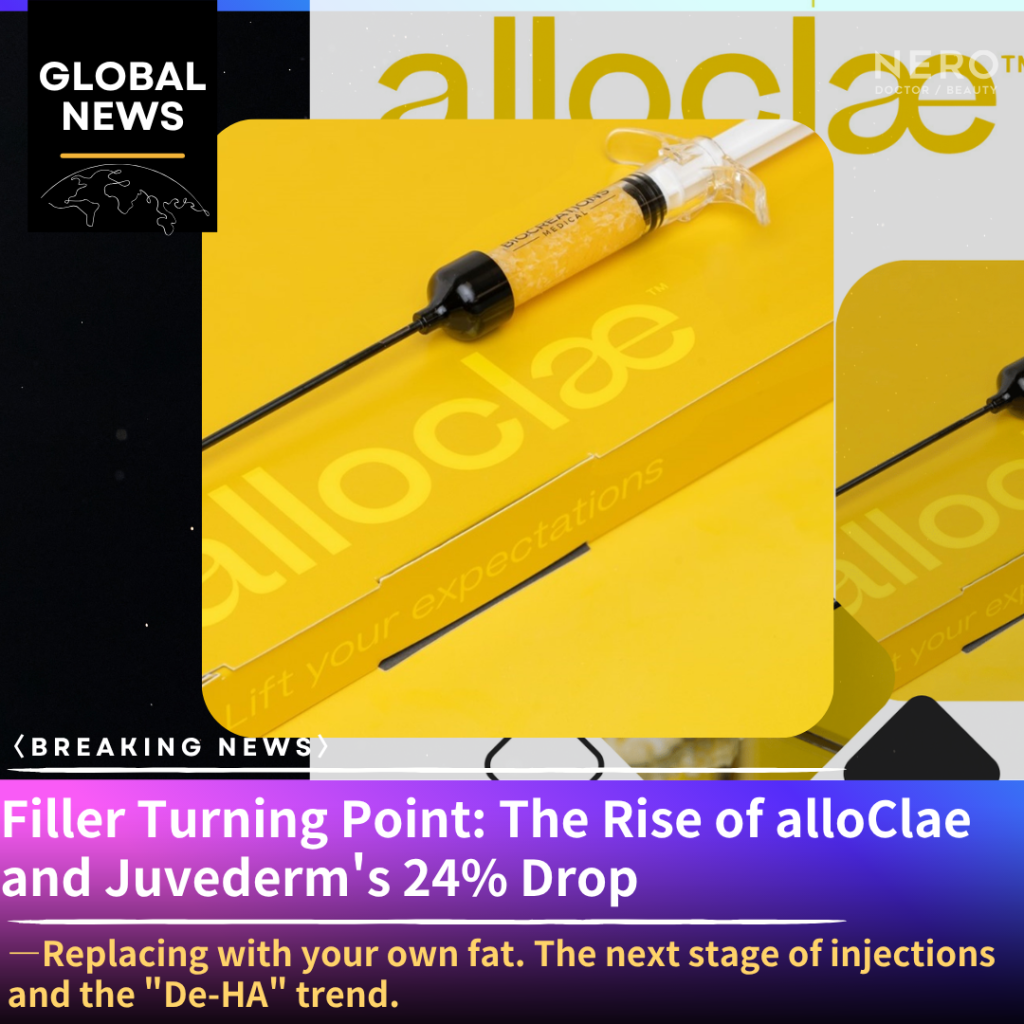
③ alloClae, the world’s first ready-to-use donor-derived adipose filler. - alloClae, launched in the U.S. in 2025 by Tiger Aesthetics Medical,
eliminates the need for liposuction surgery by using pre-processed donor fat tissue.
It is not yet approved in Japan as of June 2026.
The world’s best-known hyaluronic acid filler brand just posted its worst quarterly performance in years.
AbbVie’s Juvederm recorded a 24% year-over-year revenue decline in Q2 2025, according to the company’s SEC filing.
But the headline number tells only part of the story.
Competing brands grew. Asian markets remained bullish. And a new class of injectable products —
led by donor-derived fat filler alloClae — is beginning to redefine what “volume restoration” means in aesthetic medicine.


INDEX
What Happened to Juvederm — and What the Data Actually Shows
A 24% revenue drop for the world’s dominant HA filler brand is significant.
But context matters: the broader HA filler market is not in decline.
※ Primarily in biostimulator and botulinum toxin segments
Galderma is growing. Korean brands are growing. The global HA market CAGR remains positive at 4.03%.
The accurate read is not “HA fillers are falling out of favor” —
it is that consumers are switching brands and that regional preferences are diverging sharply.
A peer-reviewed analysis published in the European Journal of Plastic Surgery (May 2026)
examined 2.3 million social media posts across regions.
The findings revealed a striking cultural split:
North America:
Backlash against the overfilled aesthetic of the 2010s — “duck lips” and pillow faces —
has hardened into a cultural association between fillers and artificiality.
High-profile celebrities publicly dissolving their fillers have amplified the narrative.
Regional sentiment score: -32 pts.
Asia (Japan, Korea, and beyond):
Precision micro-injection techniques emphasizing natural enhancement —
glass skin, subtle volume — remain aspirational and widely accepted.
Regional sentiment score: +38 pts.
The same product category carries entirely different cultural meaning
depending on which side of the Pacific you are on.
Three Post-HA Categories Gaining Ground
“I don’t want synthetic material sitting in my face long-term.”
“I want results that look like me, not like a procedure.”
“I’ve tried HA — what comes next?”
These are the questions driving demand toward three distinct alternatives.
① Biostimulators (Sculptra, Radiesse) — Already Established in Asia
Rather than adding volume through a filler substance,
biostimulators trigger the body’s own collagen production.
Sculptra (poly-L-lactic acid) offers results lasting up to two years.
This category is also gaining traction as a facial volume restoration option
for patients experiencing GLP-1-related facial volume loss (“Ozempic face”).
② EZgel — Autologous PRF Filler Derived from the Patient’s Own Blood
EZgel is produced by drawing the patient’s blood,
extracting platelet-rich fibrin (PRF), and heating it to 75°C to form an injectable gel.
Zero additives. Near-zero allergy risk.
Rapidly expanding in Western markets as the “purist” filler alternative.
Adoption in Japan is still in early stages.
③ alloClae — The World’s First Ready-to-Use Donor Adipose Filler ★ Featured in This Article
alloClae uses donor fat tissue that has been processed and terminally sterilized,
making it injectable without requiring liposuction from the patient.
Launched in the United States in 2025 by Tiger Aesthetics Medical.
What Is alloClae — and Why “No Surgery Required” Changes the Equation
Traditional autologous fat transfer — harvesting fat from the thighs or abdomen
and transplanting it to the face or body — has always required surgery.
Downtime is significant. Donor-site scarring is a real consideration.
The barrier to entry has been high.
alloClae fundamentally lowers that barrier.
Pre-processed donor fat arrives in a ready-to-inject format,
eliminating the need for a harvesting procedure entirely.
🔬 alloClae: Five-Stage Proprietary Processing
3D honeycomb adipose architecture preserved — delivers immediate structural volume post-injection
Extracellular matrix (ECM), native collagen, and growth factors retained — supports long-term tissue regeneration
Terminal sterilization to SAL 10⁻⁶ — minimizes infection risk to the highest pharmaceutical standard
Free oil content reduced to under 2% — minimizes oil cyst formation risk post-injection
DNA content minimized — reduces immune response risk associated with allograft tissue
✅ alloClae: Key Advantages
· No liposuction or donor-site surgery required
· Large-volume application possible: 12.5–25 cc per session
· Primary indication is body contouring (breast, buttocks, hip dips, body contour defects) —
the manufacturer defines use as subcutaneous injection into localized body areas
where adipose tissue naturally exists
· Processed to minimize allergy and immune response despite donor origin
· ECM scaffold supports collagen production for regenerative benefit
⚠️ Important Considerations
· As an allograft (donor-derived tissue), the risk profile differs from synthetic HA fillers.
Contraindicated in patients with severe allergy history or prior anaphylaxis
· Launched in 2025 — long-term clinical data remains limited
· Not approved in Japan as of June 2026; not available through domestic clinics

Reading Juvederm’s revenue decline as “the end of HA fillers” misses the point.
What the data actually shows is a market diversifying away from a single dominant brand —
while HA filler demand in Asia remains robust and growing.
What NERO wants to convey is this:
The era of “just get HA and you’re done” is giving way to an era
of understanding what you’re choosing, why, and how much.
Helping readers make that shift — from emotion to informed choice — is NERO’s purpose.
“What goes in” matters less
than “why you chose it.”
That distinction is the future of aesthetic medicine.
Summary
- Juvederm posted a 24% revenue decline in Q2 2025,
but Galderma (+12.2%) and Korean HA brands (+17.7%) continued to grow.
This is brand and regional polarization — not the collapse of the HA market. - North American filler sentiment scored -32 pts (“filler fatigue”);
Asian sentiment scored +38 pts — a documented cultural divide
(European Journal of Plastic Surgery, May 2026, peer-reviewed). - Three post-HA categories are gaining ground:
① Biostimulators (collagen induction);
② EZgel (autologous PRF);
③ alloClae (donor adipose allograft) —
each with distinct mechanisms, indications, and risk profiles. - alloClae launched in the U.S. in 2025 and is not yet approved in Japan (as of June 2026).
The diversification wave — via Sculptra, PDRN, and EZgel — has already reached Japan.
Frequently Asked Questions
The key is not which product is trending — it is whether your choice is grounded in a clear conversation with a qualified physician about your goals and anatomy.
Allograft tissue products face complex regulatory pathways in many jurisdictions.
Monitor long-term U.S. clinical data and local regulatory updates for your region.
alloClae is donor-derived, enables large-volume applications (12.5–25 cc), and is indicated for body contouring — not facial use.
The question is not which is better, but which matches your specific goal. Consult a physician to determine the right approach for your anatomy and objectives.
Sources
AbbVie Inc. “Form 8-K Q2 2025 — Global Juvederm Net Revenues Decreased 24.0%.” U.S. Securities and Exchange Commission, July 2025. /
Philipp-Dormston WG et al. “‘Filler fatigue’: media narratives, industry rhetoric, and the emergence of filler consciousness in aesthetic medicine.” European Journal of Plastic Surgery, published online May 11, 2026 (DOI: 10.1007/s00238-026-02440-8). /
Fanniel V et al. “AlloClae, A Novel Ready to Use Human Adipose Allograft: Characteristics and Biocompatibility.” Bioengineering (Basel) 2025;12(6):612. /
Tiger Aesthetics Medical. “alloClae Structural Adipose Filler.” Product information and press release, 2025. /
Verified Market Research. “Global Hyaluronic Acid Based Dermal Fillers Market 2024–2031.” November 2025. /
WWD. “Inside Aesthetic Trends Set to Take Hold in 2026.” January 6, 2026. /
Business of Fashion. “Inside the Playbook to Revive Filler Sales.” December 4, 2025.