📌 Key Takeaways
- Quality sleep genuinely improves skin —
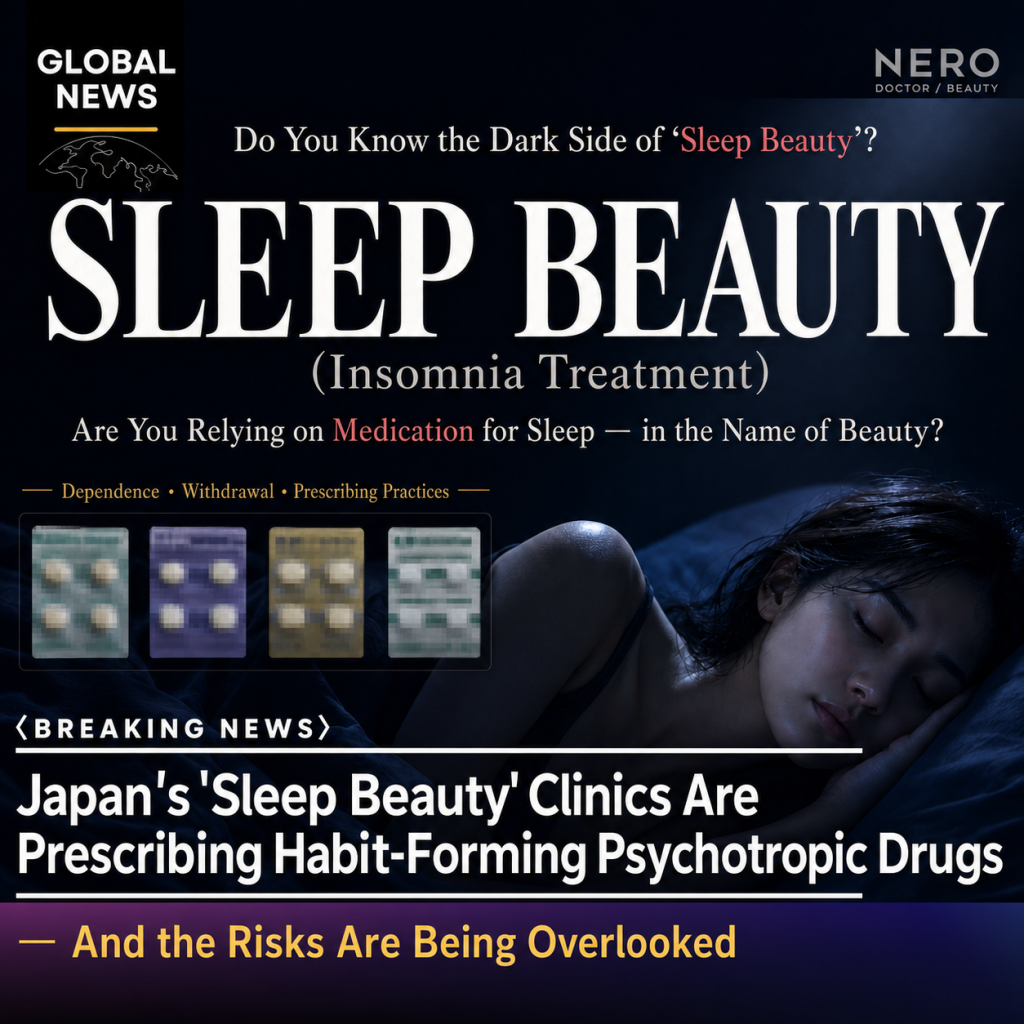
but a growing number of Japanese aesthetic clinics are marketing prescription psychotropics (Depas/etizolam, Myslee/zolpidem, Lunesta/eszopiclone) as “sleep beauty” treatments,
not lifestyle changes or supplements. - Globally, the “sleep × beauty” trend is dominated by non-pharmacological approaches —
magnesium, low-dose melatonin, and sleep hygiene —
under the banner of “Sleepmaxxing.”
Japan’s psychotropic-prescription model is an anomaly with no parallel abroad. - Depas (etizolam) is the drug psychiatrists warn about most urgently.
Designated a controlled psychotropic in 2016 due to severe dependency risk,
abrupt discontinuation can trigger intense withdrawal:
worsened insomnia, severe anxiety, tremors, and in extreme cases, seizures. - As of June 2026, a physician whistleblower has publicly warned that
general corporations are acquiring psychiatric online clinics via M&A
to commercially “sell” sleep medications and psychiatric diagnoses online —
a development described as “dependency business wearing a medical mask.”
“Sleep well, and your skin transforms” — this is scientifically sound.
During deep sleep, growth hormone peaks,
collagen resynthesis accelerates, cellular repair activates,
and the glymphatic system clears metabolic waste from the brain.
The problem is not the claim.
The problem is what some clinics are selling as the solution.
In 2026, a subset of Japanese aesthetic clinics and online telemedicine platforms
have begun marketing controlled psychotropic drugs —
the same medications psychiatrists describe as requiring careful management —
as “sleep beauty” menu items with cosmetic benefit claims.


INDEX
How the “Sleep Beauty” Business Model Works
A cash-pay (out-of-pocket) service offered by online clinics and some aesthetic practices,
marketed as “improve sleep quality to achieve better skin and beauty outcomes.”
Pricing is deliberately accessible — often starting around ¥4,620/month (approx. $30 USD) for 30 tablets —
targeting women in their 20s–40s who are reluctant to visit a psychiatrist
but want to “sleep better and look better.”
The structural driver:
As GLP-1 drugs (e.g., Mounjaro) face intensifying price competition, supply constraints, and regulatory tightening,
aesthetic clinics and telemedicine platforms have pivoted to sleep as their next high-repeat revenue category.
The dependency profile of these drugs — making them difficult to discontinue —
is noted to align conveniently with subscription (auto-renewal) business models.
By June 2026, physician whistleblowers are reporting that
general corporations are acquiring psychiatric online clinics through M&A marketplaces
specifically to commercialize sleep prescriptions and psychiatric diagnoses.
The Drugs Being Prescribed — And Why Experts Are Alarmed
These are not supplements.
They are prescription-only controlled medications requiring physician oversight.
Legal and Regulatory Risk Map
Issue ① Schemes That Hollow Out the First-Visit Online Prescription Ban
Japan’s MHLW Telemedicine Guidelines explicitly prohibit
prescribing psychotropics (Depas, Myslee, etc.) at a first online consultation.
However, a workaround is emerging:
conduct a nominal first visit using only Dayvigo (non-controlled),
then switch to psychotropics from the second visit onward —
technically compliant in form, but circumventing the guideline’s intent.
Issue ② Medical Advertising Boundaries
Advertising that leads with “sleep beauty” and “create beauty” cosmetic claims,
while appending “(insomnia treatment)” in fine print,
may constitute off-label benefit suggestion for a prescription drug —
raising questions under Japan’s Medical Advertising Guidelines.
Pairing drug names with “easy purchase” language may also constitute advertising that “undermines medical dignity.”
Issue ③ Prescribing Without Psychiatric Evaluation
Insomnia can be a symptom of depression, anxiety disorders, bipolar disorder,
or underlying physical illness — all requiring proper psychiatric assessment.
Aesthetic clinics and telemedicine platforms are unlikely to conduct
adequate psychiatric screening,
creating a real risk that treatable underlying conditions go undetected.
Issue ④ M&A Acquisition of Psychiatric Clinics and the “Diagnosis for Sale” Problem
On June 11, 2026, Dr. Kenichiro Nakata (CEO, Sakura Life Group) posted a warning on X
that rapidly circulated among medical professionals:
“On M&A marketplaces, we are seeing a surge of general corporations attempting to acquire psychiatric online clinics.
We are now seeing operations emerge that sell sleep medications and psychiatric diagnosis letters online.”
Dr. Nakata characterized the situation as:
“This is becoming a dependency business wearing a medical mask.
This needs to be regulated strictly.”
The implication: “sleep beauty” is merely the entry point —
the deeper problem is the commercialization of medical licenses through M&A.
How the Rest of the World Handles “Sleep × Beauty”
Core tools: magnesium, low-dose melatonin, white noise, room temperature control,
mouth tape, and weighted blankets.
Prescription psychotropics are entirely absent from this framework.
positioning the brand around “the science of sleep quality itself — not medication.”
identify sleep hygiene and circadian rhythm regulation as the primary intervention.
“Most people do not need supplements,” per FAU/National Geographic (2026).
The commercial model of prescribing dependency-risk psychotropics for cosmetic purposes
has no documented parallel outside Japan (NERO Research, June 2026).
💡 Sleep Does Improve Skin — The Problem Is the Method
A 2026 Sleep Foundation research review confirms that
growth hormone peaks during deep sleep,
activating collagen resynthesis, skin repair, and glymphatic waste clearance.
A separate study (Moonchild Sleep, 2026) reported a 12–18% improvement in skin elasticity
following one week of sleep optimization.
“Sleep improves skin” is a fact.
“Forcing sleep with dependency-risk psychotropics improves skin” is not scientifically supported.
Drug-induced sleep may disrupt natural sleep architecture —
the balance of deep sleep and REM —
potentially blunting the growth hormone secretion peak that drives skin repair.
A Historical Warning: The Begermin Precedent
Begermin (a combination of phenobarbital, chlorpromazine, and promethazine)
was once widely prescribed in Japan as a sleep aid.
It was discontinued in 2012 due to severe dependency risk and fatal overdose potential.
The pattern then:
“Doctors prescribed it easily.”
“Patients accessed it without friction.”
“Dependency went unrecognized until too late.”
The structural parallel to today’s “sleep beauty” business is unmistakable:
easy access → habituation → dependency → inability to stop.
The entry point differs; the mechanism does not.
Evidence-Based Alternatives: What Actually Works
- First choice: Sleep hygiene — Fixed sleep/wake times,
screen-free hour before bed, bedroom temperature 16–19°C (61–66°F).
Highest evidence base. Zero risk. - Second choice: Non-dependency supplements —
Glycine 3g, magnesium glycinate 200–400mg,
low-dose melatonin 0.5–1mg.
(Note: 5–10mg melatonin doses, common in US products, are considered excessive.) - Third choice: Specialist evaluation —
If insomnia persists, consult a psychiatrist, psychosomatic medicine specialist, or sleep physician.
CBT-I (Cognitive Behavioral Therapy for Insomnia) has the highest evidence level
of any insomnia treatment and requires no medication. - If an aesthetic clinic offers psychotropic prescriptions:
Ask explicitly about dependency risk, intended duration, discontinuation protocol,
and whether a psychiatric evaluation has been conducted.

NERO’s concern here is not about blaming aesthetic clinics.
The desire to sleep better is real.
The science linking sleep to skin health is real.
The problem is the structure in which dependency-risk psychotropics become the first answer offered to that desire.
Globally, non-pharmacological approaches define the sleep × beauty space.
What is happening in Japan reflects a structural distortion:
the “beauty” entry point reframes the clinical context of these drugs —
and that reframing carries serious consequences.
“I can’t sleep” is a medical problem.
“I want to look better” is an aesthetic one.
When you conflate the two,
you end up doing justice to neither.
Summary
- A subset of Japanese aesthetic clinics and telemedicine platforms are prescribing controlled psychotropics —
Depas (etizolam), Myslee (zolpidem), Lunesta (eszopiclone) —
as “sleep beauty” treatments.
Depas was designated a controlled psychotropic in 2016 specifically due to severe dependency risk. - Japan’s MHLW Telemedicine Guidelines prohibit psychotropic prescriptions at first online consultations,
but a workaround using Dayvigo as the first-visit drug —
then switching to controlled psychotropics from visit two onward — is raising regulatory concern. - Globally, “sleep × beauty” is a non-pharmacological category dominated by Sleepmaxxing:
magnesium, melatonin, and sleep hygiene.
Japan’s psychotropic prescription model has no documented parallel abroad. - In June 2026, a physician whistleblower warned publicly:
“General corporations are acquiring psychiatric online clinics via M&A to sell sleep drugs and psychiatric diagnoses online.”
“Sleep beauty” appears to be the entry point for a deeper commercialization of medical licenses. - For anyone experiencing insomnia,
the evidence-based first choice is evaluation by a psychiatrist or sleep specialist —
not a cash-pay aesthetic clinic.
CBT-I, sleep hygiene, and non-dependency supplements should precede any pharmacological intervention.
where sudden discontinuation can trigger withdrawal symptoms including severe rebound insomnia,
anxiety, and in serious cases, seizures.
If you have concerns, ask your prescribing physician directly about dependency risk,
intended treatment duration, and a safe tapering plan.
NERO recommends seeking a second opinion from a psychiatrist or psychosomatic medicine specialist
if you are uncertain.
carry essentially no risk and are the most evidence-supported interventions available.
Among supplements, glycine, magnesium glycinate, and low-dose melatonin (0.5–1mg)
have a reasonable safety profile.
However, the 5–10mg melatonin doses common in US over-the-counter products are considered excessive
and may reduce natural melatonin receptor sensitivity with long-term use.
Consult a physician or pharmacist before starting any supplement regimen.
not an aesthetic clinic.
Insomnia can be a symptom of depression, anxiety disorders, or other conditions
that require proper diagnosis.
CBT-I (Cognitive Behavioral Therapy for Insomnia) is the highest-evidence treatment for insomnia
and requires no medication.
Improving sleep is the most foundational beauty intervention available —
but it should be addressed through proper medical channels, not cosmetic ones.
Sources
Japan Ministry of Health, Labour and Welfare — “Guidelines for Appropriate Implementation of Telemedicine” (2022 revised edition) / MHLW — “On the Handling of Cosmetic Medicine” (August 15, 2025, Iseiei-hatsu 0815 No. 21) / Nikkei Medical Prescription Drug Database — “Depas Tablet 0.5mg” physician comments, updated June 2026 / Kokubunji East Clinic — “What is Depas (Etizolam)?” April 11, 2026 / Dr. Kenichiro Nakata (CEO, Sakura Life Group) — Post on X (@nakata_kenichiro), June 11, 2026 / Sleep Foundation — “Beauty Sleep: Why Rest and Relaxation Impact Appearance,” Daniel Noyed, May 12, 2026 / Formes de Luxe — “The formulation science behind sleepmaxxing,” June 24, 2025 / BeautyMatter — “The Biggest Ingredient Trends from In-Cosmetics 2026,” April 29, 2026 / FAU Erlangen — “Sleepmaxxing: How justified is the social media trend?” Dr. Judith Abel, March 18, 2026 / National Geographic — “Sleepmaxxing: does it actually work?” January 28, 2025 / Moonchild Sleep — “Sleepmaxxing 2026: The Ultimate Guide,” June 2026 / GoodRx — “The 10 Best Sleep Supplements, Backed by Pharmacists,” April 13, 2026