📌 Key Takeaways
- Motiva Preservé launched in the U.S. in March 2026 —
a proprietary surgical technique and instrument system,
not a new implant itself. - FDA PMA P230005 (approved September 2024) covers Motiva SmoothSilk implants —
not the Preservé instrument system or technique. - Key figures — 0.5% capsular contracture, 93% surgeon preference, 20% market share —
all originate from Establishment Labs or company-commissioned surveys,
not independent peer-reviewed research. - Board-certified surgeon Dr. Adam Kolker states:
implant placement decisions are driven by patient anatomy,
not by any specific technique or brand.
Three concerns have historically kept patients away from breast augmentation:
visible scarring, lengthy recovery, and results that look “done.”
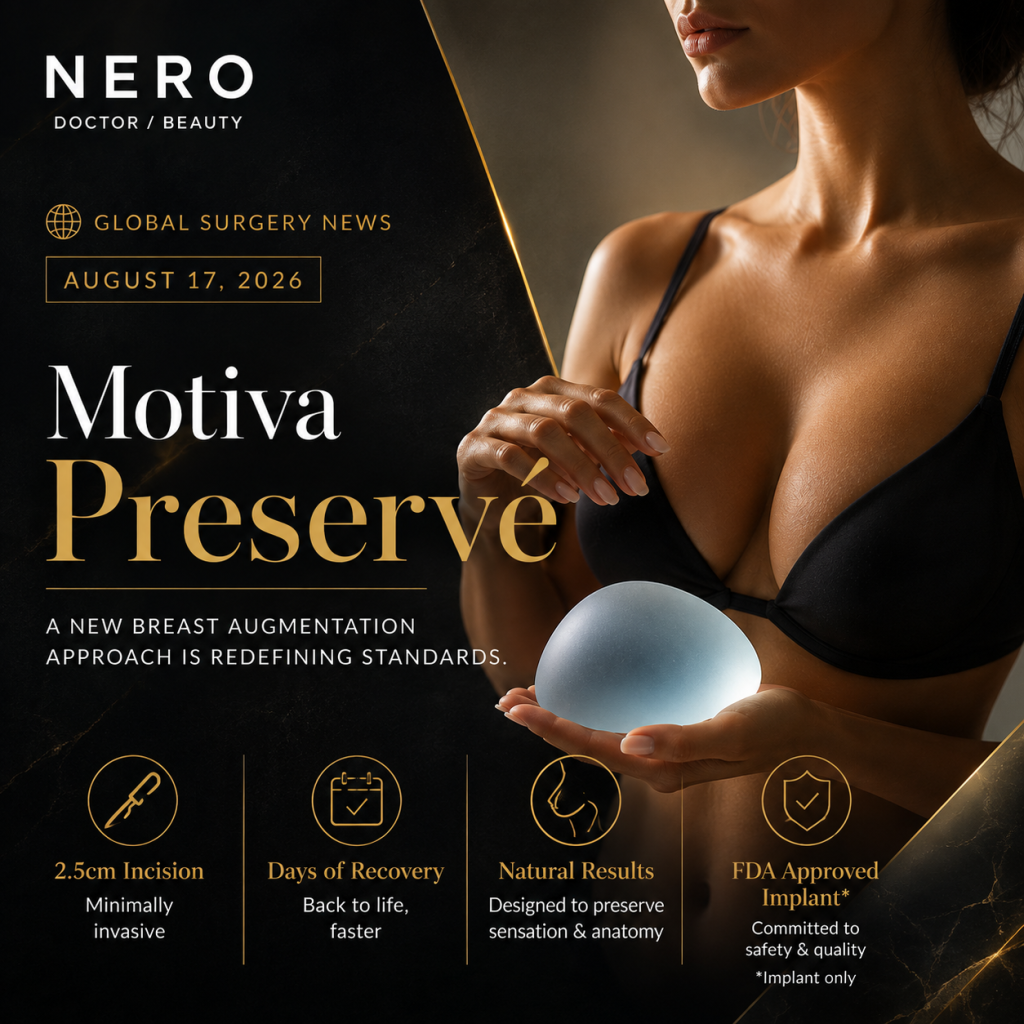
In March 2026, Establishment Labs — parent company of Motiva — launched Preservé in the United States,
positioning it as a direct answer to all three.
A 2.5cm incision. Recovery measured in days. Preserved nipple sensation.
Forbes asked the obvious question: Is this the Rolls-Royce of breast augmentation?
The numbers are striking — 93% surgeon brand preference in a survey of 60 physicians,
approximately 20% U.S. market share (per company disclosure).
But the more important question is whether those numbers hold up to scrutiny.
NERO separates the manufacturer’s claims from the clinical evidence.


INDEX
What Is Motiva Preservé — and How Does It Differ from Conventional Augmentation?
Preservé is not a new implant.
It is a proprietary surgical technique and instrument system
designed to work with Motiva’s existing implant lineup.
Currently, Preservé is compatible only with the SmoothSilk Ergonomix implant —
a design engineered to shift shape in response to body movement.
The SmoothSilk Round implant is not yet supported under the Preservé system.
A 2.5cm incision is made in the inframammary fold.
Specialized instruments navigate around breast ligaments, vessels, and nerves.
The implant is placed above the muscle (subglandular),
enabling recovery in days rather than the conventional 4–6 weeks.
The technique claims to preserve nipple sensation and muscle integrity.
Marketed as a “scarless” or minimally visible augmentation approach.
Note: The above reflects company and media claims.
These have not been fully verified through independent clinical trials.
What the FDA Has — and Has Not — Approved
This is the most critical distinction in evaluating Preservé.
FDA PMA P230005 (decision date: September 26, 2024) approves
Motiva SmoothSilk Round Ergonomix and SmoothSilk Round silicone gel-filled breast implants
for breast augmentation in women aged 22 and older — both primary and revision procedures.
The Preservé instrument system and surgical technique are not included in this PMA approval.
As of Establishment Labs’ February 2025 press release,
the company explicitly stated that the medical devices used in Preservé
were “not cleared for commercial distribution in the United States.”
Whether the March 2026 U.S. launch reflects a change in regulatory status —
such as a limited clearance or specific exemption framework —
cannot be confirmed from primary sources at this time.
NERO cannot characterize Preservé as an “FDA-approved technique” based on available documentation.
To be precise:
“Motiva implants are FDA-approved” — this is accurate.
“Preservé is an FDA-approved surgical technique” — this cannot be confirmed at this time.
Patients considering this procedure should ask their surgeon directly
about the regulatory status of both the implant and the instrument system.
Breaking Down the Numbers: 0.5%, 93%, and 20%
Forbes cited several figures that deserve closer examination.
Each number’s origin matters as much as the number itself.
Every figure in this table originates from Establishment Labs, Motiva,
or surveys commissioned by the company.
None have been independently verified through peer-reviewed research.
The distinction between “impressive numbers” and “scientifically established data” is not a minor one.
Capsular contracture — the hardening of scar tissue around a breast implant —
is the most commonly cited long-term complication of breast augmentation.
Published long-term studies report rates ranging from 2.5% to 19%.
The FDA places the lifetime risk at up to 28%.
A 2023 systematic review covering 4,784 cases did find a contracture rate of 0.54% for Motiva implants —
consistent with the company’s 0.5% claim.
However, the review authors themselves flagged key limitations:
short follow-up periods, retrospective study designs,
and partial industry involvement in the research.
Long-term independent confirmation remains ongoing.
What Independent Surgeons Are Saying
The Forbes article is notable for including a substantive counterpoint —
not just promotional commentary.
New York–based double board-certified plastic surgeon Dr. Adam Kolker
offered a perspective that reframes the entire conversation:
What matters most is where the implant is placed.
Whether above or below the muscle is determined 100% by the patient’s anatomy and goals —
not by any particular surgical technique.
Motiva makes an excellent implant, and Preservé is a thoughtful addition to the toolkit.
But the best outcomes still come from understanding anatomy,
selecting the right technique for the right patient,
and executing that surgery with exceptional precision.”
Dr. Kolker’s statement does not dismiss Motiva or Preservé.
But it firmly repositions the conversation:
no implant brand or technique produces good outcomes independently of surgeon judgment.
The question patients should be asking is not “which implant is best”
but “why is this surgeon recommending this approach for my specific anatomy and goals?”
The Market Reality Behind Preservé’s Launch
Motiva’s marketing resonates because it targets a real and large unmet need.
the single most common cosmetic surgery in this age group
The 30–39 demographic represents the largest segment of breast augmentation patients in the U.S.
Many in this group have historically avoided the procedure
due to concerns about scarring and extended recovery time.
Preservé’s claim that 15% of its patients had not previously considered augmentation
reflects a deliberate strategy to convert hesitant consumers into new demand.
The “Rolls-Royce” framing in Forbes is part of the same strategy:
a 30–50% price premium over conventional augmentation,
a luxury brand positioning,
and a celebrity partnership with Meghan Trainor generating 1.8 billion impressions.
Motiva is not just selling a technique.
It is attempting to reframe the cultural perception of breast augmentation itself.
NERO’s assessment: Motiva has genuinely introduced a new option to the field.
But just as a Rolls-Royce is not the right vehicle for every driver,
Preservé is not the right approach for every patient.
The surgeon’s ability to assess individual anatomy and explain that reasoning
is the prerequisite for any technique to deliver its claimed benefits.

The “2.5cm incision, days of recovery” message is genuinely compelling.
It makes sense that patients who had given up on augmentation
would reconsider when they hear this.
But nearly every number in this story comes from Motiva itself
or from surveys the company commissioned.
“The company says so” and “clinical trials have established this”
are two very different standards of evidence.
Dr. Kolker’s comment is the most important line in the Forbes piece.
“Placement decisions are driven by patient anatomy, not by technique” —
this doesn’t invalidate Motiva.
But it firmly rejects the idea that any brand or system
produces good outcomes on its own.
At your consultation, ask your surgeon:
“Why is this approach right for my anatomy specifically?”
If they can’t answer that clearly, keep looking.
Summary
- Motiva Preservé, launched in the U.S. in March 2026 by Establishment Labs,
is a proprietary surgical instrument system and technique —
not a new implant.
Currently compatible only with the SmoothSilk Ergonomix implant.
Claims include a 2.5cm incision, above-muscle placement,
days of recovery, and preserved nipple sensation. - FDA PMA P230005 (approved September 26, 2024) covers Motiva SmoothSilk implants.
The Preservé instrument system and technique are not confirmed
as FDA-approved under this or any other currently identified authorization.
“Motiva implants are FDA-approved” and “Preservé is an FDA-approved technique”
are not equivalent statements. - The figures cited — 0.5% capsular contracture (5-year), 93% surgeon preference,
20% U.S. market share — all originate from Establishment Labs
or company-commissioned surveys.
None have been independently verified through peer-reviewed research. - Dr. Adam Kolker, double board-certified plastic surgeon, states:
“The most important factor is not the implant but where it is placed,
and that decision is 100% determined by the patient’s anatomy and goals.”
Surgeon judgment — not brand or technique — remains the primary determinant of outcomes.
why are you recommending this specific technique and implant?”
in the country where I am having this procedure?”
what is your protocol and what are my options?”
Availability of the Preservé instrument system and technique varies by country
and is subject to each nation’s medical device regulatory framework.
Patients should confirm the regulatory status of both the implant and the technique
directly with their surgeon and the relevant health authority before proceeding.
potentially causing pain, distortion, or implant displacement.
It is classified on a Grade I–IV scale, with Grade III–IV requiring medical intervention.
Published studies report rates ranging from 2.5% to 19% depending on follow-up duration and methodology.
The FDA places the lifetime risk at up to 28%.
Motiva reports a 5-year rate of 0.5% based on its own clinical data —
a figure supported by one 2023 systematic review (4,784 cases),
though the authors noted limitations including short follow-up and partial industry involvement.
has been primarily associated with textured-surface implants.
Motiva SmoothSilk implants use a smooth surface design.
A 2023 systematic review of 4,784 cases reported no BIA-ALCL cases with Motiva implants.
However, the authors acknowledged limitations including short observation periods
and partial industry involvement in the research.
Long-term surveillance is ongoing. Discuss this risk with your surgeon before any procedure.
Sources:
1. Sandler E. “Is Motiva Preservé The Rolls-Royce Of Breast Implants?” Forbes. August 17, 2026. forbes.com
2. FDA. PMA P230005 – Motiva SmoothSilk Breast Implants. Approved September 26, 2024. accessdata.fda.gov
3. Establishment Labs. “Establishment Labs Launches Preservé.” Press Release. February 18, 2025. investors.establishmentlabs.com
4. Motiva Official Site. Preservé Overview. motiva.health
5. Aesthetic Surgery Journal / PMC. Motiva implant 3-year prospective multicenter clinical data. pmc.ncbi.nlm.nih.gov
6. Journal of Clinical Medicine / PMC. Motiva implant systematic review (4,784 cases, 2023). pmc.ncbi.nlm.nih.gov
7. ASPS. Plastic Surgery Statistics Report 2024. plasticsurgery.org