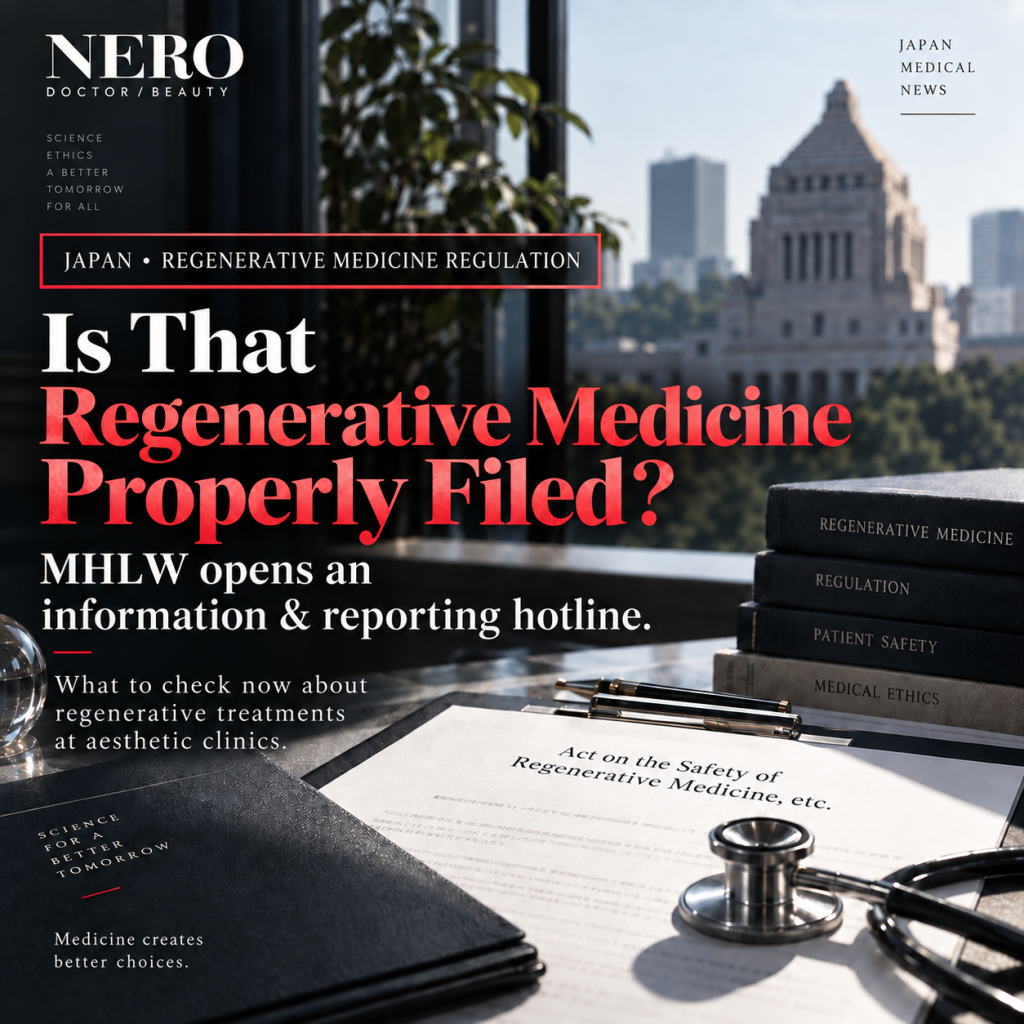
📌 Key Takeaways
- Japan’s Ministry of Health, Labour and Welfare (MHLW) launched a new anonymous reporting portal
for regenerative medicine violations, confirmed on the official mhlw.go.jp page. - The portal is not a direct enforcement or prosecution channel —
it collects information to inform regulatory supervision and guidance. - Accepted reports include: unregistered treatment plans, missing ethics committee reviews,
and serious safety incidents. Advertising violations and civil disputes are out of scope. - Japan’s Act on the Safety of Regenerative Medicine (2014) requires clinics offering
cell-based treatments — including stem cells, PRP, and exosomes —
to file a treatment plan and pass committee review before proceeding.
Clinics advertising “stem cell IV drips” and “regenerative anti-aging” treatments
have become increasingly common across Japan’s aesthetic medicine market.
But a critical question often goes unasked:
have these clinics actually filed the required documentation under Japan’s regenerative medicine law?
On September 2, 2026, Japan’s Ministry of Health, Labour and Welfare (MHLW) formalized a channel
to receive exactly this kind of concern —
the “Regenerative Medicine Information and Reporting Portal” (再生医療等情報提供・通報窓口).
Anonymous submissions are accepted.
But this is not a hotline that triggers immediate raids or license revocations.
Reading the official language precisely matters.


INDEX
What the MHLW Portal Actually Does — and Doesn’t Do
The official MHLW page (mhlw.go.jp, directly verified) states the following:
“The Ministry of Health, Labour and Welfare accepts information and reports
regarding the provision of regenerative medicine,
in order to ensure the safety and proper implementation of regenerative medicine.”
“Submitted information will be used as reference for understanding the proper implementation status
of regenerative medicine, and for necessary supervision and guidance.”
“In principle, this portal does not provide individual responses or replies.
We are also unable to respond individually regarding whether an investigation will be conducted
or whether results will be disclosed.”
The portal’s purpose is information gathering → reference for regulatory oversight.
It does not guarantee investigation, enforcement action, or any public disclosure of outcomes.
Submitters should not expect a response.
· Suspected absence of Certified Regenerative Medicine Committee review
· Treatment being conducted differently from the filed plan
· Reports of serious health injuries
· Suspected problems with infection control or quality management
· Safety management issues in cell collection, processing, or administration
→ Submit to the Medical Institution Net Patrol (MHLW-commissioned, separate channel)
· Personal disputes over medical fees, contracts, or treatment outcomes
· General consumer complaints unrelated to legal compliance
· For full exclusion criteria, consult the official MHLW portal page
Japan’s Act on the Safety of Regenerative Medicine — The Legal Framework
Japan’s Act on the Safety of Regenerative Medicine (再生医療安全性確保法),
enacted in 2014, governs any clinic — including aesthetic medicine clinics —
that offers cell-based treatments such as stem cells, PRP, or exosomes.
Three core requirements apply:
(or regional bureau) and receive formal acceptance before treatment begins.
required for Class I and Class II risk-tier treatments.
notified to the Minister of Health, Labour and Welfare.
Filing under Japan’s Regenerative Medicine Act confirms procedural compliance —
not that a treatment has been proven safe or effective.
Registration is the minimum legal threshold.
It is a separate question from whether the treatment has demonstrated clinical benefit
in peer-reviewed research.
Three Reporting Channels — Understanding the Difference
Japan now has multiple channels for reporting aesthetic medicine concerns.
Knowing which to use matters:
Scope: Suspected violations of the Regenerative Medicine Act —
unregistered plans, missing committee review, safety management failures
Out of scope: Advertising violations, civil disputes, consumer complaints
Response: None (used as reference for supervision and guidance)
Scope: General aesthetic medicine complaints — treatment dissatisfaction,
inadequate explanation, medical disputes
URL: biyo-meyasubako.jp
Note: JSAPS and JSAS (Japan Society of Aesthetic Surgery, plastic surgery-affiliated)
are separate organizations — do not confuse the two.
Use this channel for advertising issues that fall outside the regenerative medicine portal
URL: iryoukoukoku-patrol.mhlw.go.jp
What to Ask Before Receiving Regenerative Medicine Treatment
Can you provide the plan registration number?”
If registered, the plan number may be verifiable through the relevant regional health bureau.
“It’s widely used” or “it works” is not evidence. Ask for specific published research.
and how does the clinic manage post-treatment complications?”
Cell-based procedures carry theoretical risks including infection, immune reactions,
and tumor formation. Choose a clinic that can explain these clearly.
Verify the treatment plan filing, committee review, and cell processing facility registration.
A clinic marketing “regenerative medicine” may not have completed any of these steps.
The term “regenerative medicine” appears widely in aesthetic clinic advertising —
but whether a clinic has actually filed the required documentation
is impossible to determine from marketing materials alone.
The launch of this reporting portal signals that Japan’s health ministry
recognizes a gap between what is being marketed and what is being properly registered.
For clinics, the ability to clearly communicate compliance —
treatment plan number, committee review status, cell processing facility registration —
is becoming a foundational element of patient trust.
This portal is not an enforcement weapon.
But accumulated reports will shape where regulatory attention is directed.
Summary
- Japan’s MHLW launched the Regenerative Medicine Information and Reporting Portal
(confirmed on mhlw.go.jp).
Its stated purpose: to collect information for use in regulatory supervision and guidance.
Anonymous submissions accepted. - Accepted reports include: suspected unregistered treatment plans,
missing committee review, and serious safety incidents.
Advertising violations, civil disputes, and consumer complaints are out of scope.
No individual responses or investigation disclosures will be provided. - Japan’s Act on the Safety of Regenerative Medicine (2014) requires clinics
offering cell-based treatments to file a treatment plan,
pass committee review, and register cell processing facilities.
Filing does not constitute proof of efficacy or safety. - Three separate channels now exist: the MHLW regenerative medicine portal,
the JSAPS Aesthetic Medicine Meyasubako (biyo-meyasubako.jp),
and the MHLW-commissioned Medical Institution Net Patrol.
Each covers a distinct scope — use the correct channel for your concern.
The MHLW portal explicitly states it does not provide individual responses,
and will not disclose whether an investigation has been initiated or what its outcome was.
Reports are used as reference material for supervision and guidance decisions —
not as direct triggers for enforcement action.
This channel is not designed for resolving personal disputes or obtaining refunds.
that the clinic has filed the required plan and undergone committee review.
It does not mean the treatment has been proven clinically effective or safe
through peer-reviewed research.
These are separate questions that patients should ask independently.
legal compliance under the Regenerative Medicine Act —
unregistered plans, missing committee review, and safety management failures.
The Aesthetic Medicine Meyasubako, operated by JSAPS (Japan Society of Aesthetic Plastic Surgery),
handles broader aesthetic medicine complaints including treatment dissatisfaction
and inadequate informed consent.
They serve different purposes and are operated by entirely separate organizations.
Sources:
1. Ministry of Health, Labour and Welfare (Japan). “Regenerative Medicine Information and Reporting Portal.” mhlw.go.jp (Primary source, directly verified)
2. Medical Institution Net Patrol (MHLW-commissioned). iryoukoukoku-patrol.mhlw.go.jp
3. Japan Society of Aesthetic Plastic Surgery (JSAPS). Aesthetic Medicine Meyasubako. biyo-meyasubako.jp