📌 Key Takeaways
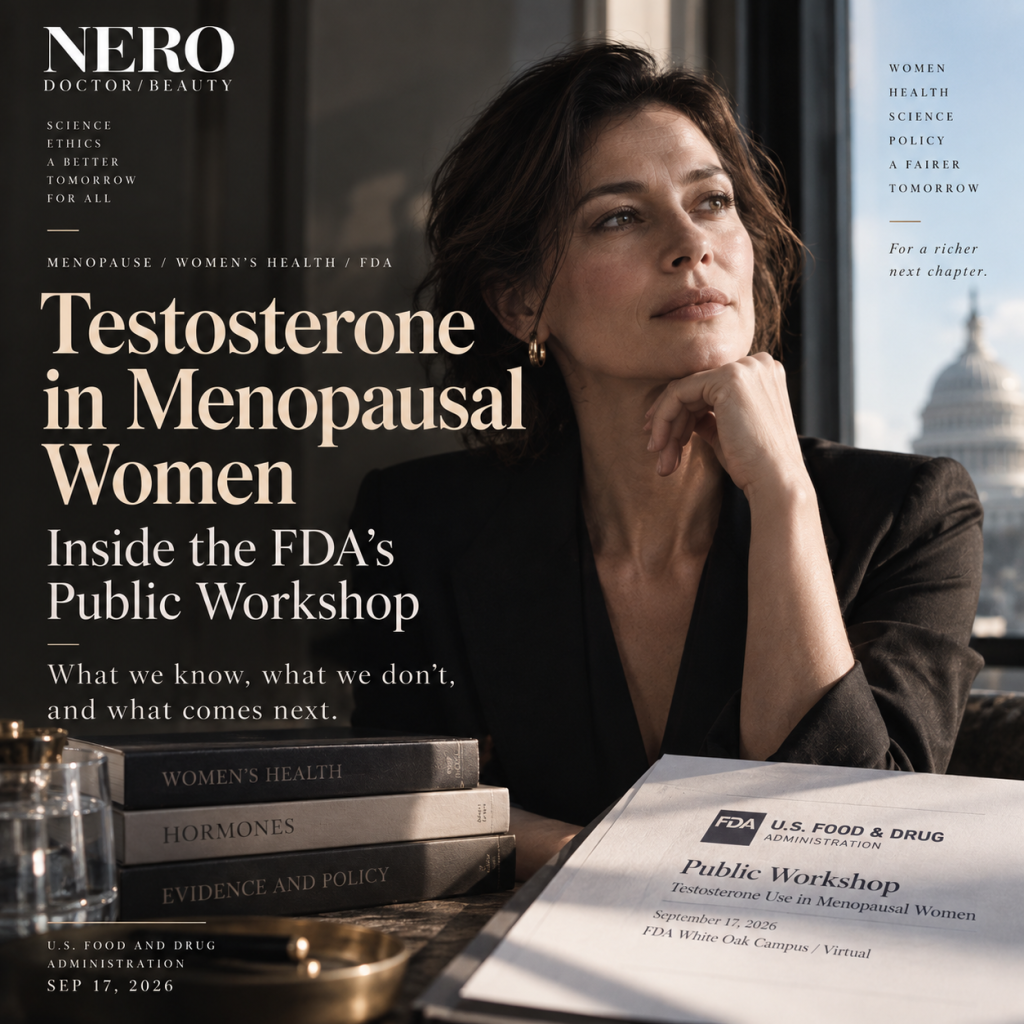
- The FDA’s Office of Women’s Health (OWH) and CDER are hosting a public workshop titled “Testosterone Use in Menopausal Women” on September 17, 2026 —
open to the public via YouTube and in-person at FDA White Oak Campus. - There is currently no FDA-approved testosterone therapy for menopausal women in the United States,
yet off-label use is rising significantly. - The FDA has identified 8 critical knowledge gaps — including sexual function, cognition, mood, cardiovascular risk,
breast cancer risk, and long-term safety data. - Professional societies (NAMS, ISSWSH) support testosterone use for HSDD (Hypoactive Sexual Desire Disorder) in postmenopausal women —
but this remains the only evidence-based indication.
“My sex drive has dropped since menopause.”
“My testosterone levels are low.”
These are real concerns for many women —
yet in the United States, there is no FDA-approved testosterone therapy specifically indicated for menopausal women.
That regulatory gap is now under formal scrutiny.
The FDA’s Office of Women’s Health (OWH) and Center for Drug Evaluation and Research (CDER)
have announced a public workshop on September 17, 2026,
titled “Testosterone Use in Menopausal Women.”
This is not an approval announcement.
The FDA’s stated purpose is to map what is not yet known —
and to identify directions for future research and potential drug development.
Here is what the evidence actually shows, and what remains unresolved.


INDEX
- Why Off-Label Testosterone Use Is Rising — and Why the FDA Is Paying Attention
- Workshop Details — What’s Being Discussed and When to Submit Comments
- 8 Knowledge Gaps the FDA Has Identified — What Remains Unknown
- What Professional Societies Say — HSDD Evidence and Its Limits
- Why “Female LOH” Is a Misleading Term — A Conceptual Clarification
- The Global Regulatory Context — What This Means Beyond the U.S.
Why Off-Label Testosterone Use Is Rising — and Why the FDA Is Paying Attention
Testosterone is often framed as a male hormone,
but women’s bodies produce it too — via the ovaries and adrenal glands.
Levels decline with age and menopause.
The FDA’s official workshop page states directly:
“Menopause is characterized by a significant decline in ovarian hormones, including testosterone.
Off-label use of testosterone therapy in menopausal women is increasing,
but important knowledge gaps remain.
These include effects on sexual function, cognition, mood, and musculoskeletal health;
challenges in measuring and interpreting testosterone levels in women;
and a lack of long-term safety data, particularly regarding cardiovascular and breast cancer risk.”
The current situation can be summarized as follows:
• Women’s testosterone decline is real and physiologically documented.
• Demand exists, and off-label prescribing is increasing.
• No FDA-approved indication exists for menopausal women.
• Long-term safety data remain insufficient.
The workshop is designed to map this gap publicly — not to close it immediately.
Workshop Details — What’s Being Discussed and When to Submit Comments
+ Live stream via YouTube
+ Center for Drug Evaluation and Research (CDER)
Docket: FDA-2026-N-5479 on Regulations.gov
8 Knowledge Gaps the FDA Has Identified — What Remains Unknown
Based on the FDA’s official workshop page and the Federal Register notice,
NERO has organized the outstanding questions into 8 domains.
(Note: The FDA does not number these as a formal list — this is NERO’s editorial synthesis.)
assay methods remain inconsistent
What Professional Societies Say — HSDD Evidence and Its Limits
At the level of professional medical societies,
there is meaningful evidence for one specific indication.
both endorse testosterone therapy for postmenopausal women diagnosed with HSDD (Hypoactive Sexual Desire Disorder),
based on available evidence.
• The 2019 Global Consensus Position Statement (published in PMC)
identifies HSDD as the “only evidence-based indication” for testosterone use in women.
are not yet established.
• Long-term cardiovascular and breast cancer risk data remain inadequate.
• These uses fall outside current evidence-based recommendations.
Why “Female LOH” Is a Misleading Term — A Conceptual Clarification
In social media and some aesthetic clinic marketing,
the phrase “female LOH” (female Late-Onset Hypogonadism) has appeared
to describe testosterone decline in menopausal women.
Neither the FDA nor professional societies use this term —
and NERO considers it conceptually inaccurate.
LOH (Late-Onset Hypogonadism) is a male-specific diagnostic concept,
grounded in age-related decline of the testicular-hypothalamic-pituitary axis.
Testosterone decline in women is better understood as a physiological change
associated with menopause — driven by ovarian and adrenal function shifts.
Applying the “LOH” label to women implies that testosterone replacement is a natural or necessary intervention.
This framing conflicts with the clinical reality:
outside of HSDD, no evidence-based indication for testosterone therapy in women has been established.
More accurate language: “Menopause-related testosterone decline”
or “androgen-related changes during menopause.”
The Global Regulatory Context — What This Means Beyond the U.S.
The FDA workshop does not directly affect drug approval processes in other countries.
However, when major regulatory bodies like the FDA and EMA systematically gather evidence
and define research priorities,
their findings tend to inform clinical guidelines globally — including in markets
where testosterone therapy for women is currently offered off-label or outside insurance coverage.
For women currently considering testosterone therapy,
the key facts to understand are:
• No FDA-approved testosterone product exists for menopausal women — any use is off-label.
• HSDD is the only indication with established evidence from professional societies.
• Long-term safety data on cardiovascular and breast cancer risk are insufficient.
• Testosterone measurement in women lacks standardized reference ranges —
“low” does not automatically mean “needs supplementation.”
The FDA convened this workshop precisely because the evidence is not yet sufficient.
Rising demand does not equal established safety or efficacy —
that principle has not changed.
From a clinical standpoint, testosterone therapy for HSDD is an area
where professional societies have done meaningful evidence synthesis.
But claims about vitality, cognition, and musculoskeletal benefits
are not supported by established evidence.
Any clinical discussion should explicitly acknowledge off-label status
and engage in individualized risk-benefit assessment.
- The FDA’s OWH and CDER are hosting a public workshop on September 17, 2026 —
“Testosterone Use in Menopausal Women” — in hybrid format (in-person + YouTube).
Public comments accepted until October 19, 2026 via Regulations.gov docket FDA-2026-N-5479. - There is currently no FDA-approved testosterone therapy for menopausal women.
Off-label use is increasing, and the FDA has identified 8 knowledge gaps
spanning sexual function, cognition, mood, musculoskeletal health, measurement,
cardiovascular risk, breast cancer risk, and long-term safety. - NAMS, ISSWSH, and the 2019 Global Consensus Statement support testosterone use
for postmenopausal women with HSDD — identified as the only evidence-based indication.
Benefits beyond HSDD (cognition, vitality, etc.) are not established. - The term “female LOH” is conceptually inaccurate and should not be used.
This workshop does not signal imminent FDA approval —
it is a structured effort to define what research is still needed.
the FDA itself lists this as a knowledge gap.
“Low” does not automatically indicate a need for supplementation.
If your primary concern is reduced libido (HSDD) or fatigue,
a comprehensive evaluation at a menopause or gynecology clinic is recommended,
including assessment of estrogen and progestogen levels.
If testosterone therapy is being considered,
discuss its off-label status and the limited long-term safety data with your physician.
The stated purpose of this workshop is to “examine the current state of the science
and identify knowledge gaps to inform future research and potential drug development” (FDA.gov).
No product application is under review.
FDA approval requires a separate submission and review process.
This workshop is a preliminary step — mapping what is not yet known,
not announcing what has been decided.
insurance coverage is generally not available for this use.
Patients typically pay out-of-pocket for compounded or off-label testosterone products.
This regulatory and coverage gap is part of what the FDA workshop aims to address
by building the evidence base for potential future approval pathways.
Sources:
1. FDA Office of Women’s Health. “FDA Public Meeting: Testosterone Use In Menopausal Women — 09/17/2026.” fda.gov (Primary source, directly verified)
2. Federal Register. “Testosterone Use in Menopausal Women; Public Workshop; Request for Comments.” federalregister.gov
3. Global Consensus Position Statement on the Use of Testosterone Therapy for Women (2019). Journal of Sexual Medicine. PMC6821450