📌 Key Takeaways
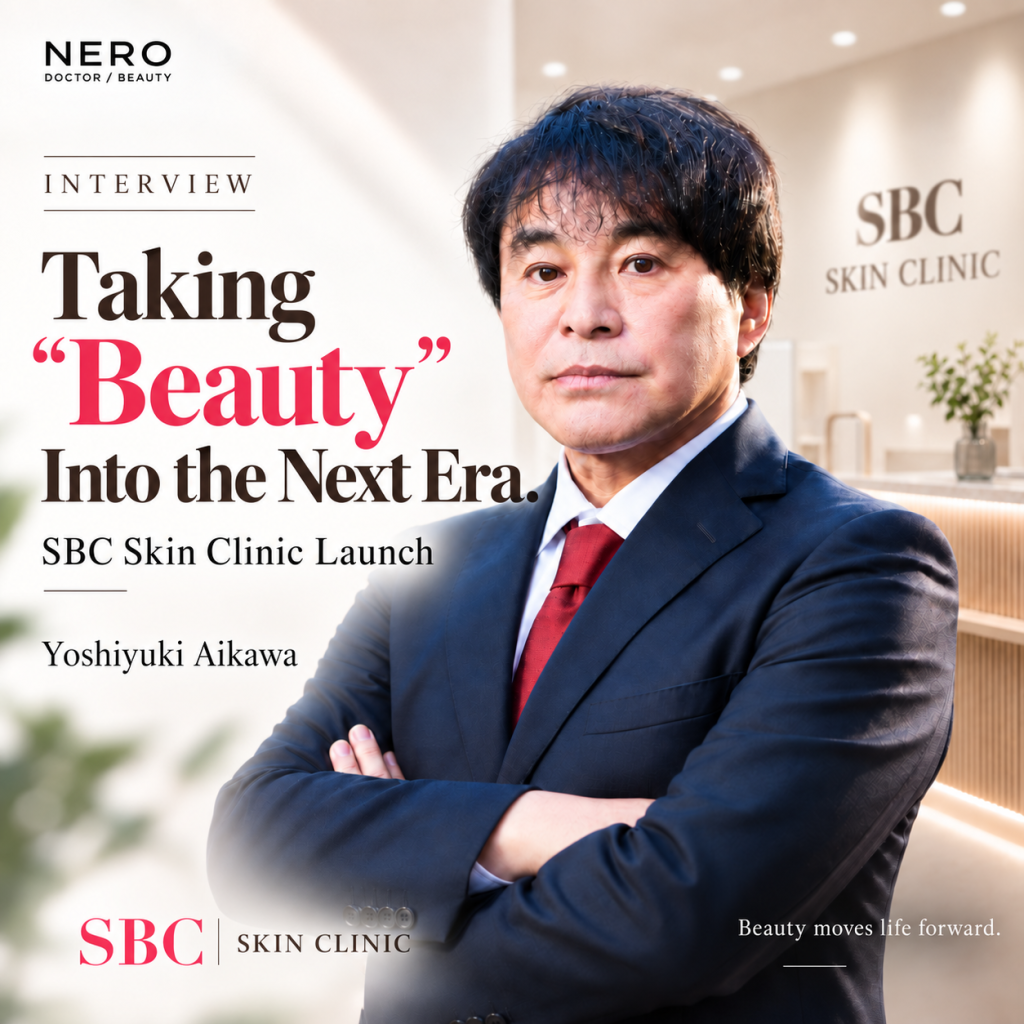
- On September 12, 2026, SBC Medical Group rebrands 14 “Shonan Beauty Dermatology” clinics across Japan
as “SBC Skin Clinic” — dropping one of the country’s most recognized aesthetic medicine names. - CEO Yoshiyuki Aikawa, who opened the first clinic in Fujisawa, Kanagawa in 2000,
says the rebrand reflects a 26-year-old mission: making skin care a daily habit, not a special occasion. - The group — NASDAQ-listed since 2024, with 287 locations and 6.9 million annual visits —
is pursuing a multi-brand strategy and a new “Longevity Center” concept by 2027. - Korean actor Park Seo-jun stars in the new TV campaign, delivering all lines in Japanese —
a deliberate choice that signals cultural convergence over mere K-beauty branding.
There is a moment most people recognize.
You catch your reflection in a bus window on the way home from work.
Or you glance at yourself in an elevator mirror and think:
“I look tired. Older than I feel.”
And then, almost immediately, a second thought follows:
“But I don’t actually want to look younger. Not exactly.”
That feeling has never had a clean name.
It is not anti-aging. It is not rejuvenation.
It is something quieter — a desire to stay close to yourself, over time.
On September 12, 2026, a new television commercial from SBC Medical Group will air across Japan,
built around exactly that moment.
On the same day, 14 clinics operating under the name “Shonan Beauty Dermatology” (湘南美容皮フ科)
will become “SBC Skin Clinic.”
To understand why, it helps to go back 26 years.
· What a NASDAQ-listed company means when it says “scale is not the goal”
· Why a Korean actor was cast to deliver every line in Japanese
· What “Longevity Company” signals about the next chapter of aesthetic medicine
Recommendations for or against specific treatments or clinics.
Evaluation of individual treatment efficacy or safety.
Estimated reading time: approx. 10 minutes
Graduated Nihon University School of Medicine, 1997.
Opened the first clinic in Fujisawa, Kanagawa in March 2000.
Now oversees management support for 287 locations worldwide (as of June 2026, including affiliated networks).
Listed on NASDAQ in September 2024.


INDEX
- Q1. In 2000, He Decided to Make Something “Special” into Something Ordinary
- Q2. What a NASDAQ-Listed Company Means When It Says “Scale Is Not the Goal”
- Q3. One Name Would Be More Efficient. So Why Divide?
- Q4. Holding Japan’s Most Recognized Name — and Choosing a Different One
- Q5. A Korean Actor Who Delivered Every Line in Japanese
- Q6. An Aesthetic Medicine Company Moves Toward Preventive Health
- A Framework for Readers: Five Questions Worth Asking
Q1. In 2000, He Decided to Make Something “Special” into Something Ordinary
aesthetic medicine in Japan occupied a very different cultural space.
The idea that people might visit a clinic the way they visit a hair salon
was, by the standards of the industry at the time, a radical departure.
What did you see that led you there?
When I opened the Fujisawa clinic in 2000 — the origin of what would become Shonan Beauty Clinic —
aesthetic medicine was expensive and exclusive, accessible only to a limited few.
I wanted to deliver high-quality medical care to a much broader audience,
and to make it as approachable as visiting a hair salon.
That meant rethinking pricing, accessibility, and the entire structure of how people engage with these services.
as a natural, recurring part of life.”
That framing sounds familiar today.
But in 2000, saying it out loud meant questioning the industry’s foundational assumptions.
What makes it more interesting is that 26 years later, the destination has still not fully arrived.
had used aesthetic medicine in the past year — the highest of any age group.
By their 50s, that figure drops to 4.3%.
Usage declines steadily with age.
The same survey identified “resolving a specific concern” as the top reason for visiting.
In other words, Japan’s aesthetic medicine market still functions primarily as a destination
for fixing something specific — not as a recurring wellness habit.
When the concern is resolved, patients stop coming.
That is precisely the pattern Aikawa set out to change in 2000.
What he was challenging was not just the price — it was the visit pattern itself.
Source: Recruit / HotPepper Beauty Academy, “Beauty Census 2025 H2 — Aesthetic Medicine Edition” (Aug 4–18, 2025; n=13,200)
Q2. What a NASDAQ-Listed Company Means When It Says “Scale Is Not the Goal”
You listed on NASDAQ in 2024.
Yet in your message to our editorial team, you wrote:
“Our purpose is not simply to grow the size of our company or our clinics.”
How does that statement hold up for a publicly traded company
facing growth-oriented capital markets?
We have expanded beyond aesthetic medicine into dentistry, ophthalmology, orthopedics,
and fertility treatment — now supporting over 250 medical institutions in Japan and abroad.
We listed on NASDAQ in 2024, but our purpose is not simply to grow in scale.
We apply the management expertise we have built in aesthetic medicine
to support medical institutions more broadly —
protecting employment for the people who work there,
and preserving community healthcare.
That, too, is a core part of what we do.
for an aesthetic medicine company.
But it makes structural sense for a company whose core business is management support —
not clinic ownership.
The distinction matters: SBC is not a company that opens clinics.
It is a company that keeps clinics running.
SBC Medical Group’s domestic business model is primarily that of an MSO
(Medical Service Organization) —
providing advertising, staffing, equipment procurement, and facility leasing
to independently owned and operated medical corporations.
The 287-location figure (Form 10-K: 259 as of December 31, 2025;
Q2 2026 IR: 287) includes affiliated and partner networks,
not solely Shonan Beauty Clinic–branded locations.
Overseas, the group directly owns and operates 21 locations in Singapore
and one in Ho Chi Minh City, Vietnam.
Q3. One Name Would Be More Efficient. So Why Divide?
separating brands by treatment category and patient profile.
From a conventional business standpoint,
consolidating under one well-known name would be more efficient —
lower advertising costs, simpler operations.
Why divide?
As the range of what people seek from medicine has diversified,
it has become increasingly difficult for a single brand to address everything.
Our multi-brand strategy separates brands by treatment category and patient need,
making each brand’s focus and specialization immediately legible.
Shinagawa Aesthetic Surgery has long operated “Shinagawa Aesthetic Surgery”
and “Shinagawa Skin Clinic” as distinct entities.
But SBC’s segmentation goes further than treatment category.
The group’s portfolio includes Shonan Beauty Clinic, SBC Skin Clinic (formerly Shonan Beauty Dermatology),
SBC Itaewon Beauty Clinic, NEO Skin Clinic, Hada no Aozora Clinic,
Rize Clinic, and Gorilla Clinic — each targeting a distinct patient profile:
K-beauty-oriented, insurance-plus-private-pay hybrid, male-focused, and more.
Dividing brands means deciding in advance who walks through each door.
It sacrifices efficiency in exchange for specificity of entry point.
※ This paragraph reflects editorial interpretation.
Q4. Holding Japan’s Most Recognized Name — and Choosing a Different One
“Shonan” is arguably the most recognized name in Japanese aesthetic medicine.
This is a significant strategic decision to walk away from.
What are you gaining — and what are you letting go?
As part of this strategy, on September 12, 2026,
we are renaming all 14 “Shonan Beauty Dermatology” clinics nationwide to “SBC Skin Clinic.”
As skin care reaches a broader range of age groups,
we want the name itself to communicate clearly
that this is a clinic focused on the skin — not on surgical procedures.
Our goal is to make skin care not a special occasion,
but an everyday choice that fits naturally into how people live.
which specializes in aesthetic dermatology.
The “Shonan Beauty Clinic” brand continues unchanged.
This is not a group-wide renaming — it is the launch of a distinct brand
for dermatology-focused care.
Reading this response, our editorial team noticed something.
The language echoes almost exactly what Aikawa said 26 years ago.
Placed side by side, the parallel is striking.
I wanted to make it as approachable as visiting a hair salon.“
but an everyday choice that fits naturally into how people live.”
In 2000, the tools were price and location.
In 2026, the tool is a name.
The instrument has shifted. The destination has not.
※ This reading reflects editorial interpretation.
The brand documentation offers one more line worth quoting.
It describes the starting point of the rebrand this way:
How should we reframe the role of aesthetic dermatology — and communicate that reframing to society —
while respecting diverse definitions of beauty and ways of living?
This question was the starting point for the rebrand.”
They began with a question, not an answer.
That is not a common way for a corporate brand document to open.
NERO also places questions — not conclusions — at the center of its editorial practice.
So this line left an impression.
Adding “approachability” to that list signals something specific about intent.
A one-time visit requires trust. A recurring relationship requires comfort.
The name, the interior, the color palette — all point in the same direction.
※ This paragraph reflects editorial interpretation.
Q5. A Korean Actor Who Delivered Every Line in Japanese
one of South Korea’s most prominent actors.
Based on our research, this appears to be an uncommon choice
for a Japanese aesthetic medicine clinic.
More notably, he delivers every line in Japanese —
not Korean.
If the goal were to leverage K-beauty associations,
Korean would be the stronger signal.
What were you trying to communicate with this casting —
and with this language choice?
For the new “Yell Series” TV campaign launching on the same day,
we cast Park Seo-jun — an actor who represents South Korea’s beauty culture
and commands broad generational appeal.
Through his natural, refined presence,
we wanted to convey not the pursuit of looking younger or conforming to a specific ideal of beauty,
but the importance of facing your own skin on its own terms
and choosing care that fits who you are.
but choosing care that fits who you are.”
That is an unusual thing for an aesthetic medicine advertisement to say.
Most campaigns in this category sell a transformation — a “you can look like this.”
This one says, in effect: “You don’t have to.”
The campaign copy follows the same logic:
“Have you heard of ‘skin investment’?”
“Thinking about your future skin, starting now.”
Derived from the Korean “피부관리” (pibu gwanri — literally “skin management”),
the term refers to the practice of maintaining skin condition systematically over time.
In Japan, it began appearing in clinic and salon menus around 2023.
The Korean Dermatological Association states on its official site:
“Not only treating diseased skin, but managing skin and maintaining healthy skin
is also an important role of the dermatologist.”
As of this writing, no equivalent formal statement has been identified
in major Japanese medical society documents —
suggesting a meaningful difference in how the two countries frame
the dermatologist’s role in preventive skin care.
“Skin investment” (肌投資 / hada tōshi) is something newer — and rarer.
Our research found very few instances of it used as a conceptual term,
and no identifiable origin point.
That said, the broader frame of “beauty as investment” is already well established.
A 2023 survey found that 72.2% of women in their 20s–40s
said they actively “invest in beauty” as a regular practice.
The frame exists. The skin-specific word was waiting to be coined.
Note: The English term “skinvestment” exists in some markets,
but no evidence was found that “hada tōshi” was introduced as its translation.
※ Interpretive elements reflect editorial analysis.
The settings chosen for the commercials are equally deliberate.
A bus interior. An elevator after work.
Not aspirational spaces — spaces people pass through every single day.
Park Seo-jun delivered that line — in a language not his own —
with careful attention to distance, gaze, and expression at every take.
The shoot reportedly ended with applause from the crew.
Japan’s aesthetic medicine industry has borrowed extensively from Korean techniques and terminology.
But casting a Korean face as the public voice of a Japanese clinic
is a different kind of move — one our research suggests has few precedents in this category.
What was borrowed before was the method. This time, it is the messenger.
※ “No precedent” cannot be definitively proven. This reflects the scope of our research.
Video courtesy: SBC Medical Group
Q6. An Aesthetic Medicine Company Moves Toward Preventive Health
with plans for a “Longevity Center” by 2027.
Aesthetic medicine and preventive medicine have historically occupied separate spaces.
This is not a simple extension of existing business.
What, in your view, connects them?
SBC is now working toward becoming a “Longevity Company” —
one that supports people through what is increasingly a 100-year lifespan.
Longevity, as we understand it, means combining nutrition, exercise, medicine, and technology
to sustain a long life that is healthy and fulfilling in both body and mind.
As Japan becomes one of the world’s leading longevity societies,
we believe the role of medicine going forward is to support people
in living well — on their own terms — until the very end of their lives.
As a concrete step, we are planning to open a “Longevity Center” by 2027.
The concept is to bring together SBC’s existing specialties —
aesthetic medicine, dentistry, orthopedics, and others —
under one roof, with a particular emphasis on preventive care.
Our goal is to evolve from aesthetic medicine into comprehensive healthcare,
and to become a medical group that accompanies patients across their entire lives.
The most rigorous available evidence on early aesthetic intervention
comes from a Cochrane systematic review (2021) integrating 65 randomized controlled trials
and 14,919 participants.
That review explicitly notes that follow-up periods across included trials were at most one year,
and that “evidence on the effects of repeated treatment cycles is lacking.”
This does not mean the interventions are ineffective —
it means the long-term picture has not yet been confirmed.
The review uses the word “promising” and calls for higher-quality longitudinal research.
This is not a limitation unique to SBC — it applies to the entire field
of preventive aesthetic medicine as it currently stands.
someone needs to start building it.
A network of 287 locations and 6.9 million annual visits
represents a data infrastructure with few parallels in Japan.
If the Longevity Center genuinely pursues preventive medicine,
what it will need most is not new equipment —
but longitudinal outcome metrics.
If aesthetic medicine begins to be evaluated not just by patient satisfaction
but by time-indexed health indicators,
that would represent a meaningful shift for the entire industry.
※ This paragraph reflects editorial perspective.
A Framework for Readers: Five Questions Worth Asking
Regardless of which clinic you choose,
the following questions tend to surface what matters most.
Prevention always implies a timeframe.
Whether the benefit is projected over one year or ten years
makes an enormous difference to the strength of the evidence behind it.
Efficacy claims without a comparison group are not actionable.
Does “works” mean better than doing nothing,
or better than an alternative approach?
Starting conditions are discussed often. Stopping conditions rarely are.
A practitioner who can articulate exit criteria
is a meaningful signal of clinical honesty.
Whether something qualifies as an “investment” depends not on how you pay,
but on whether outcomes are reviewed.
Ask what is recorded, when it is reviewed, what is included, and what the exit terms are.
How a practitioner handles the elimination question
reveals more about their priorities than any recommendation they volunteer.
A ranked list is more useful than a comprehensive one.

Aesthetic medicine has long been narrated around rejuvenation — the past self as the reference point.
In recent years, a different frame has entered the global conversation: skin longevity.
Not how young you can look, but how long you can sustain what you have now.
The reference point shifts from the past to the future.
This rebrand, read through that lens, is an attempt to translate that shift into Japanese.
Not “look younger” — but “keep loving your skin. Always.”
The same treatment, chosen from a different baseline, lands differently.
For the reader, that difference is the most important thing.
the language of 2000 and the language of 2026 are nearly identical.
Over 26 years, what changed was the instrument — from price and access to brand name.
The destination did not move.
That kind of consistency is rare in business.
What I find most significant is the act of separation itself.
Medicine that restructures the face and medicine that extends the skin’s timeline
operate on different visit frequencies, different outcome metrics, different patient relationships.
If the goals are different, the entry points should be different too.
This rebrand can be read as a direct translation of a global debate —
“rejuvenation” versus “skin longevity” — into brand architecture.
And because preventive claims require long-term metrics that no one in this field has yet established,
NERO intends to stay close to that process as it unfolds.
The new brand statement opens with this:
Easy to begin. Easy to continue.”
“Easy to begin” is something 26 years of price reduction and clinic expansion has addressed.
“Easy to continue” is the problem that remains unsolved.
And the evidence for what continuing actually does — over time, at scale —
is still being written, by everyone in this field, everywhere in the world.
“Keep loving your skin. Always.”
The final line of the commercial is not a call to look younger.
It is a call to stay close to yourself — over time.
From one clinic in Fujisawa in 2000, to this moment in 2026.
What changed, and what did not —
both arrive at the same place on September 12.
- On September 12, 2026, SBC Medical Group renames 14 “Shonan Beauty Dermatology” clinics
as “SBC Skin Clinic” — a dermatology-focused brand distinct from the continuing “Shonan Beauty Clinic.” - CEO Yoshiyuki Aikawa’s stated rationale in 2026 mirrors his founding vision from 2000:
making skin care a daily habit rather than a special occasion. - The multi-brand strategy sacrifices name recognition for clarity of patient entry point —
a deliberate trade-off, not an oversight. - Korean actor Park Seo-jun delivers all campaign lines in Japanese,
signaling cultural integration rather than K-beauty signaling. - The group’s planned “Longevity Center” (target: 2027) enters a field
where long-term preventive evidence remains limited — making its data potential significant.
These clinics will become “SBC Skin Clinic,” with updated logos, websites, interior design, and clinical positioning.
The “Shonan Beauty Clinic” brand continues unchanged.
This is not a group-wide renaming — it is the creation of a distinct brand for dermatology-focused care.
“Skin management” (肌管理) derives from the Korean “피부관리” and emphasizes maintaining current skin condition.
“Skin investment” (肌投資) frames present choices in relation to future outcomes — a forward-looking lens.
“Skin investment” is still an emerging term without a fixed social definition;
its meaning may vary depending on context and speaker.
Aesthetic surgery involves incisions and structural interventions — fat, bone, and facial architecture.
Aesthetic dermatology focuses on the skin itself (epidermis to dermis) using lasers, injectables, topicals, and oral medications.
The boundary is not always clean — concerns like skin laxity may be addressed by either approach.
The scope of services varies by clinic; always verify with the specific institution you are considering.
This rebrand makes the distinction legible at the level of the clinic name itself.
Sources:
1. SBC Medical Group press release: “Park Seo-jun to appear in new TV CM for medical aging care ‘Yell Series'” (September 3, 2026); CEO Yoshiyuki Aikawa message to NERO editorial team. [Corporate announcement]
2. SBC Medical Group, “SBC Skin Clinic Logo Guidelines” Ver.1.1, July 28, 2026. [Corporate document]
3. Recruit / HotPepper Beauty Academy, “Beauty Census 2025 H2 — Aesthetic Medicine Edition” (published December 11, 2025; survey conducted August 4–18, 2025; n=13,200). Link [Internet survey; sampling limitations apply]
4. SBC Medical Group Holdings Incorporated. Form 10-K (fiscal year ended December 31, 2025). U.S. Securities and Exchange Commission. Link
5. SBC Medical Group Holdings Incorporated. “Reports Second Quarter 2026 Financial Results.” August 13, 2026. [Corporate announcement, preliminary figures]
6. Camargo CP, et al. “Botulinum toxin type A for facial wrinkles.” Cochrane Database of Systematic Reviews. 2021;7:CD011301. DOI: 10.1002/14651858.CD011301.pub2 [Systematic review: 65 RCTs, 14,919 participants; max follow-up 1 year]
7. Marinelli G, et al. “Proactive Aesthetic Strategies: Evaluating the Preventive Role of Botulinum Toxin in Facial Aging.” Muscles. 2025;4(3):31. DOI: 10.3390/muscles4030031 [Systematic review, 9 studies; authors conclude “promising but further longitudinal research needed”]
8. Korean Dermatological Association, “Skin Management” official page. Link
9. Rize Clinic, “Survey on Beauty Investment” (October 18–19, 2023; n=1,200, women and men ages 20–40s). Link [Corporate announcement; internet survey]
10. Japan Ministry of Health, Labour and Welfare, “Guidelines on Advertising of Medical Services” (Medical Policy Notice No. 0508-1, May 8, 2018; last revised March 30, 2026).
CM key visuals, production stills, and clinic interior images in this article
were provided by SBC Medical Group as press materials.
Article structure, editorial framing, and source selection were determined independently by the NERO editorial team.
This article is not a sponsored or advertorial placement.