📌 Key Takeaways
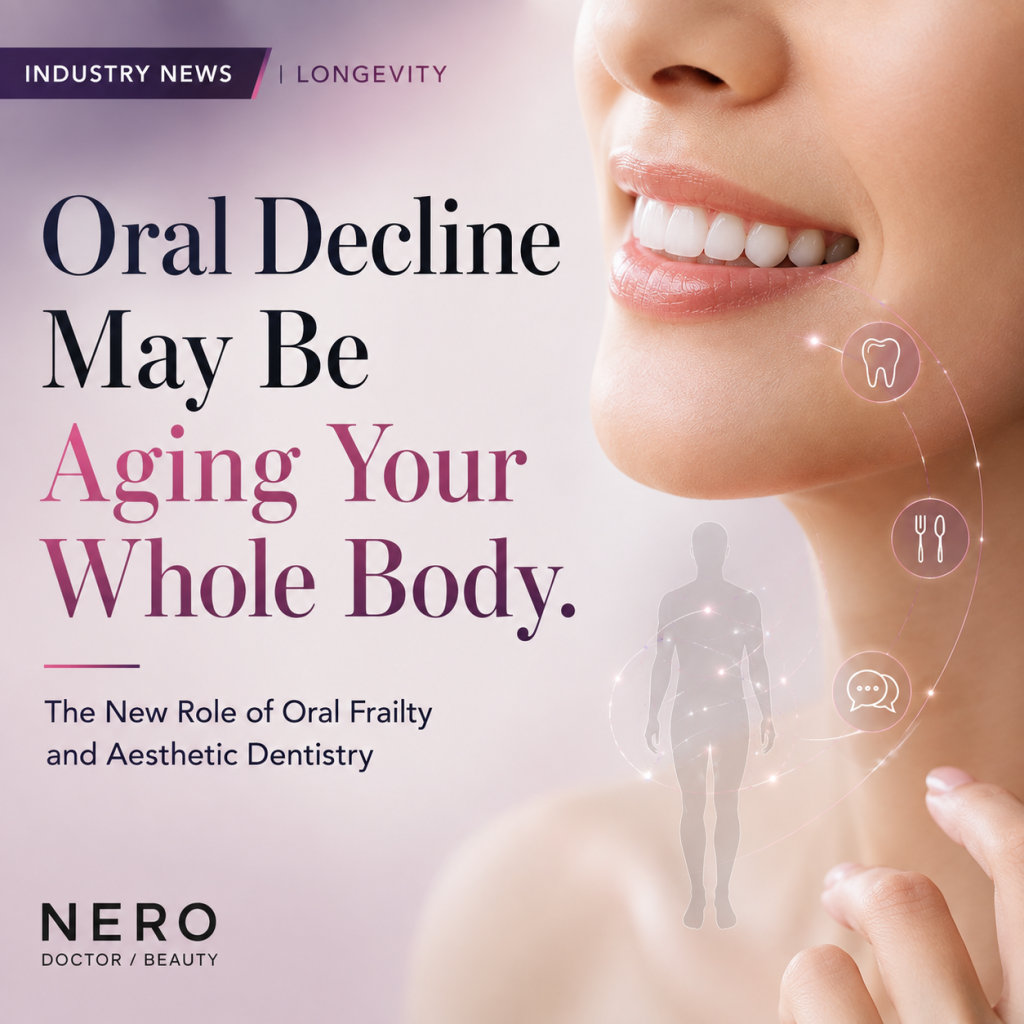
- Oral frailty — the gradual decline in chewing, speaking, and swallowing —
is now recognized as a gateway to systemic aging and physical frailty. - A 2025 commentary in Nature Aging calls for oral health indicators
to be embedded in multidimensional frailty assessment models. - The three pathways linking oral decline to whole-body aging are:
chronic inflammation, malnutrition, and social isolation. - Aesthetic dentistry is expanding beyond whitening
toward a broader role as a gateway to healthy longevity.
When most people think of dental aesthetics, they think of whiteness.
But the true value of a healthy mouth extends far beyond appearance.
The ability to chew, speak, and swallow — and the gradual loss of those abilities —
turns out to be one of the clearest mirrors of how the entire body ages.
In October 2025, Nature Aging published a commentary by leading researchers
arguing that oral health should be formally integrated into aging and frailty evaluation.
The implications reach well beyond geriatrics —
and quietly reframe what aesthetic dentistry is for.


INDEX
🦷 What Is Oral Frailty — and Why Does It Affect the Whole Body?
Oral frailty refers to the gradual decline in oral functions —
chewing, speaking, and swallowing — that precedes more severe physical frailty.
It sits in the reversible zone between full health and dependency,
making early detection especially valuable.
Relevance to aesthetic medicine: oral function and oral appearance are inseparable —
a mouth that looks healthy should also work well.
The mouth is the entry point for eating and communication —
two of the most fundamental daily acts.
When oral function declines, the effects ripple outward —
quietly but systematically — across the entire body.
The Nature Aging commentary, published October 17, 2025
(December 2025 issue), identifies three specific pathways
through which oral health connects to systemic aging and frailty:
that may accelerate aging across multiple organ systems.
nutrient deficiency, and progressive muscle loss.
reduces social engagement, accelerating cognitive and emotional decline.
Difficulty chewing → soft food only → nutritional imbalance →
muscle loss → further physical decline.
This cascade, originating in the mouth, can meaningfully accelerate whole-body aging.
🌍 A Global Shift: Integrating Oral Indicators Into Frailty Assessment
The core argument of the Nature Aging commentary is precise:
oral health data — already collected in many longitudinal aging studies —
should be incorporated into multidimensional frailty models.
The goal is threefold: improve predictive accuracy, enable earlier intervention,
and support more comprehensive care for aging populations.
This represents a meaningful shift in how the global research community
thinks about aging assessment —
moving from organ-specific metrics toward integrated, whole-person models
that include the mouth as a core data point.
The Nature Aging publication is a commentary — an expert opinion piece —
not a primary research study or clinical trial.
It argues for the value of integrating oral indicators,
not that oral care definitively halts aging.
Readers should interpret this as a directional signal from the research community,
not a confirmed clinical protocol.
💎 Aesthetic Dentistry’s Expanding Role: From Whitening to Longevity Gateway
This emerging framework quietly reframes what aesthetic dentistry is for.
Whitening and cosmetic restoration remain valuable —
but they are no longer the full story.
The mouth is increasingly understood as a gateway to healthy longevity:
a site where early signs of systemic decline can be detected,
and where intervention may have outsized downstream effects.
or a noticeable decline in speech clarity —
are early signals worth discussing with a dental professional.
Early awareness is the first step in breaking the negative cycle.
inflammation, nutrition, and systemic aging
will resonate more deeply with prevention-oriented patients.
Communicating “whitening + function” as a unified value proposition
positions aesthetic dentistry within the longevity medicine conversation.
builds trust with health-conscious demographics.

Many people still think of the mouth purely in terms of appearance.
But chewing connects to nutrition, and speech connects to mental health and social belonging.
The mouth is a far more powerful gateway to whole-body health than most of us realize.
That’s why aesthetic dentistry is evolving —
from “how your smile looks” to “how well your mouth serves your life.”
At NERO, we’ll keep tracking this shift with the care it deserves.
✨ Summary
- Oral frailty — the decline in chewing, speaking, and swallowing —
is linked to systemic aging through inflammation, malnutrition, and social isolation. - Nature Aging (October 2025) published a commentary calling for oral health indicators
to be embedded in multidimensional frailty models —
though this is an expert opinion, not a confirmed clinical finding. - Aesthetic dentistry is expanding its role:
from cosmetic whitening toward a broader function as a gateway to healthy longevity.
💬 Frequently Asked Questions
frequent choking or coughing while eating,
and a noticeable decline in speech clarity or articulation.
These subtle changes are worth raising with a dental or medical professional early —
before they progress into more significant functional decline.
It argues that oral health indicators have value as part of a broader frailty assessment framework.
The relationship is directional and plausible — but not yet confirmed by large-scale clinical trials.
supporting the ability to chew, speak, and engage socially with confidence.
As oral health becomes integrated into longevity medicine,
dental practices that communicate this broader value will be better placed
to serve prevention-focused patients.
Source: “Embedding oral health indicators into multidimensional frailty models.” Nature Aging (Comment). Published October 17, 2025 / December 2025 issue. nature.com
Note: This publication is an expert commentary, not a primary research study. Findings should be interpreted as a directional proposal from the research community.