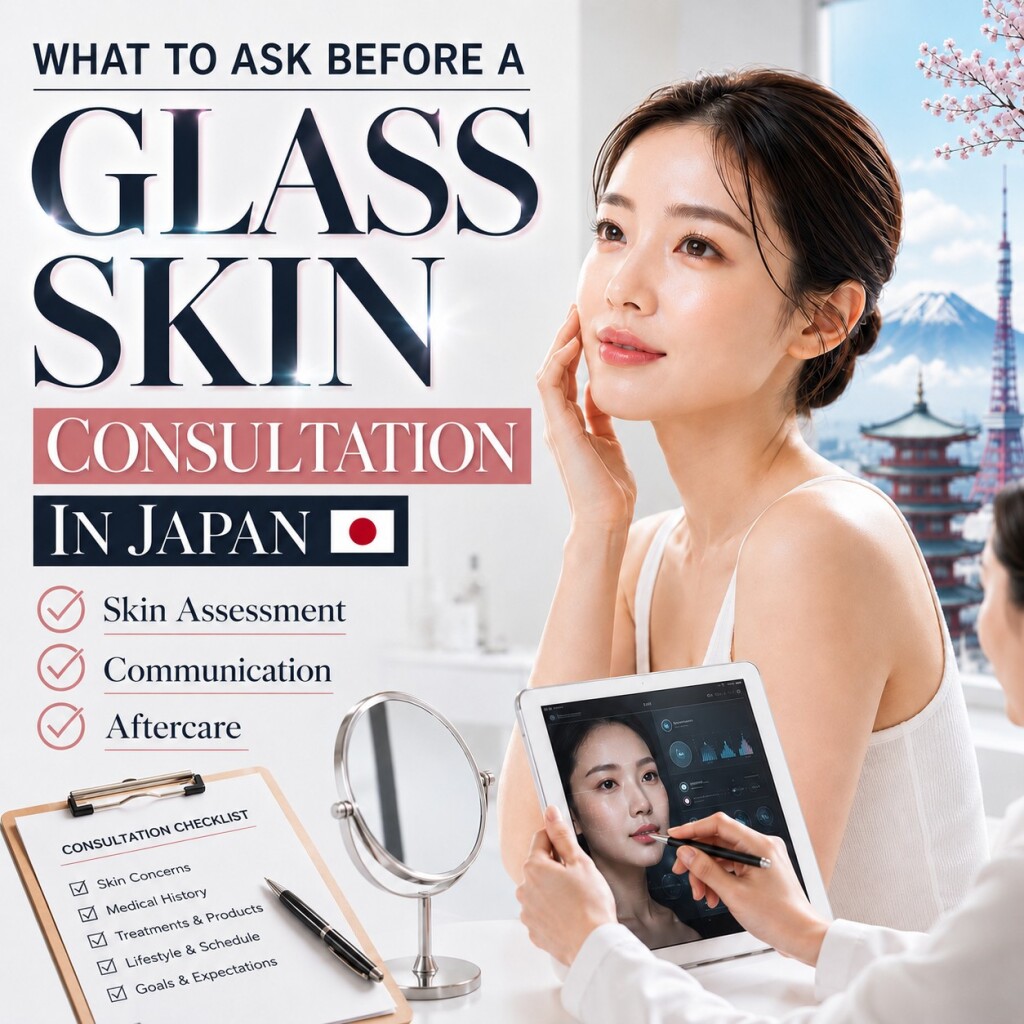
“Glass Skin” describes a look, not a procedure. Readers who search for it in Japan are usually thinking about smooth texture, even tone, and a clear, light-reflecting surface — goals that different clinicians may approach in very different ways.
This article helps you prepare for a consultation: what an individual assessment should cover, what history to bring, and what to ask about rationale, downtime, and follow-up.
It does not diagnose, recommend a treatment, or identify a clinic. There is no universal best option, and suitability is an individual clinical question.


INDEX
- What “Glass Skin” Usually Means—and What It Does Not Mean
- What a Personalized Skin Assessment Should Cover
- Treatment Options You May Encounter in Japan
- How to Share Your Skin History Clearly
- Questions About Treatment Rationale, Downtime, and Follow-Up
- Choosing a Clinic: English Communication and Transparent Case Information
- How to Plan Around a Short Stay in Japan
- Consultation Checklist
- FAQs
What “Glass Skin” Usually Means—and What It Does Not Mean
The term travels well because it is visual rather than technical.
Someone using it may be describing several different things at once: pores that look less obvious under light, a surface without flaking or roughness, tone that reads as even from a normal viewing distance, or skin that simply holds moisture better than it used to.
What the term does not describe is a condition, a diagnosis, or a defined clinical endpoint.
wo people can use the same phrase and be describing different concerns — one focused on texture after years of acne, another on dullness and dehydration, another on pigment that shifts with sun exposure. A clinician cannot plan around a phrase alone.
It also does not describe a fixed result.
Skin appearance is affected by lighting, camera settings, make-up, hydration, sleep, and photo editing, and images circulating online are rarely neutral documentation.
Treating an image as a target outcome sets up a comparison that no clinician can promise to meet.
This matters for your consultation in a practical way.
If you arrive asking for “Glass Skin,” the conversation starts with interpretation. If you arrive describing what you notice, when you notice it, and what has changed, the conversation starts with information.
The rest of this guide is about building that second version.
What a Personalized Skin Assessment Should Cover
An individual assessment is the part of the appointment where a clinician works out what is actually happening with your skin before discussing any option.

It is reasonable to ask what that assessment will involve before you book.
Broadly, it should cover your current skin condition, your history, and your circumstances.
Current condition includes what is visible and palpable now — texture, oil and dryness patterns, active inflammation, existing marks or discoloration, and any areas that are sensitive or reactive.
History includes how your skin has responded in the past: to sun exposure, to inflammation such as acne or eczema, to previous procedures, and to prescription or over-the-counter products.
Circumstances include medications, relevant health history, allergies, pregnancy or breastfeeding where applicable, your skincare routine as it actually is rather than as intended, and your schedule — including travel.
You may encounter the Fitzpatrick scale during this conversation. It can be one discussion tool among several, but it is not a measure of race, ethnicity, or nationality, and it does not on its own determine whether a treatment is suitable for you 1.
If a clinic uses it, it is fair to ask what else is being assessed alongside it.
A useful assessment also names uncertainty. Skin does not respond identically in every person, and part of a careful discussion is hearing where a clinician expects variation, what would change the plan, and what they would want to observe before continuing.
If you want context on how the goal itself is framed locally, it may help to read about what people commonly mean by “Glass Skin” in Tokyo before your appointment.
Treatment Options You May Encounter in Japan
The categories below are the ones that commonly come up when texture, tone, and hydration goals are discussed.
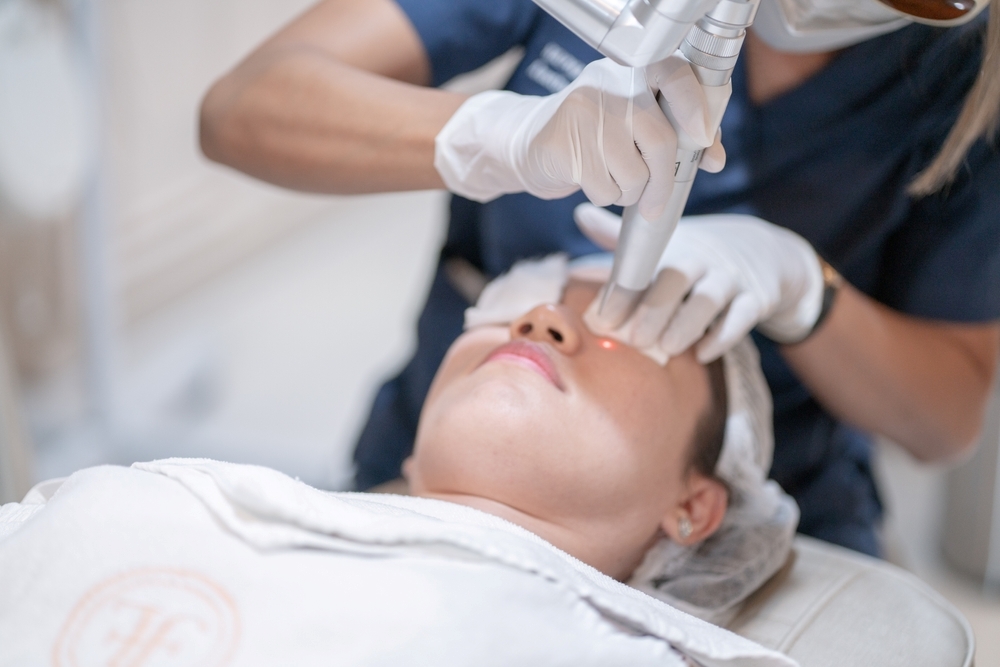
They are listed so that you recognize terminology in a consultation — not as a menu to choose from, and not in any order of preference. This article deliberately does not explain any single procedure in depth; that is the clinician’s job, in the context of your assessment.
Treatment availability, product and device status in Japan, clinician technique, treatment protocol, cost, recovery, and individual suitability can vary.
A product or device name alone does not determine whether an option is appropriate for you. Confirm current details directly with the treating clinic.
| What readers commonly want to discuss | Examples readers may encounter in Japan | Questions to ask in consultation | Travel / follow-up considerations |
| Surface roughness, flaking, dullnes | Surface renewal and peeling approaches, including glycolic acid or salicylic acid macrogol peels | Why this category for my skin now? What alternatives exist? | How soon can I be in sun, wear make-up, or fly? |
| Pore appearance and textural irregularity | RF microneedling approaches such as POTENZA or Morpheus8; fractional laser approaches | How many sessions are typically discussed, and what happens if I only have one? | What downtime is expected, and can I observe it before leaving Japan? |
| Uneven tone and pigment | Laser and light-based treatments such as Pico laser; clinician-led topical plans | What pigment-related risks apply to me, and how would they be managed? | Who reviews changes after I return home? |
| Hydration, plumpness, fine lines | Injectable skin-quality products such as hyaluronic-acid based skin boosters, Rejuran, or Profhilo | What is the expected duration, and what does maintenance involve? | Is a follow-up appointment needed within my stay? |
| Ongoing home care between visits | Clinician-led topical or oral plans under supervision | How does this interact with my current products? | Can I obtain or continue this after leaving Japan? |
Pigment change after inflammation or after a procedure is a recognized clinical topic and a reasonable thing to raise directly, particularly if you have noticed marks lingering after spots, cuts, or previous treatments 2.
Ask how it would be discussed in your case rather than assuming it does or does not apply to you.
Consultations are short, and interpretation adds friction. A brief written summary — in English, on your phone or on paper — makes the appointment more useful and reduces what gets lost in translation.
Useful things to prepare:
- A timeline. When your main concern started, whether it is stable, seasonal, or worsening, and what was happening around the time it changed.
- Product names as written. Photograph the labels of what you currently use, including prescriptions. Brand names differ between countries; the packaging is clearer than a translation.
- Prior procedures. What category, roughly when, how many sessions, and how your skin responded — including anything that took longer to settle than you expected.
- Reaction history. Sunburn and tanning patterns, marks left after acne or injury, reactions to products, and any known allergies.
- Medications and health history that a clinician would need to know, including recent isotretinoin use if applicable, and pregnancy or breastfeeding status where relevant.
- Unedited photographs. Natural light, no make-up, taken from a few angles — useful if your concern fluctuates or looks different from how it appears on the day.
Say what you want to avoid as well as what you want. Constraints — no visible redness for a work event, no peeling before a flight, no unpredictable downtime during a short trip — are clinical information, not preferences to be embarrassed about.
Questions About Treatment Rationale, Downtime, and Follow-Up
Once options are on the table, the conversation is worth slowing down.
You are not evaluating whether a clinic sounds confident; you are checking whether the reasoning is specific to you.
Ask why this category rather than another, and what would make the clinician reconsider.
Ask what happens if you do nothing for now — a clinician who can explain the trade-off of waiting is describing a considered plan rather than a sale. Ask what is expected in the days afterward, what would be outside the expected range, and who you should contact if that happens.
Downtime deserves concrete answers. “Minimal” is not a schedule.
Ask about redness, swelling, flaking, sun-exposure restrictions, make-up restrictions, exercise, and how these map onto the days you will actually be in Japan.
Ask what is typically felt during and after the appointment, and what is offered for comfort.
Follow-up deserves the same specificity. Ask when a review would normally happen, what is being watched for, and how that works if you are not in the country.
If a plan assumes several sessions, ask what a single session realistically addresses on its own.
Where a specific procedure comes up repeatedly in relation to this goal, it can help to read background separately — for example, how HydraFacial is discussed in relation to a Glass Skin goal — so that consultation time goes to your assessment rather than to definitions.
Choosing a Clinic: English Communication and Transparent Case Information
If you decide to compare clinics, prioritize clinics that can explain your assessment, treatment alternatives, risks, written aftercare, and follow-up contact in English or through a qualified interpreter.
Ask whether they can show relevant case information transparently — including the treatment category, number of sessions, timing of photographs, expected downtime, and material risks — without presenting another person’s result as a guarantee of yours.
Case information is worth reading carefully rather than quickly.
Look for whether the treatment category and session count are stated, when the photographs were taken relative to treatment, whether lighting, angle, and make-up are consistent, whether other procedures were performed at the same time, and whether downtime, risks, and individual variation are described.
Another person’s result is not evidence of what will happen to your skin, and a clinic presenting it as such is telling you something about how it communicates.
| Questions to ask before choosing a clinic |
| 1. Who will explain my assessment, options, risks, and aftercare in English, and how will interpretation be handled if needed? |
| 2. How will you assess my current skin condition, previous reactions, medical history, and treatment goals? |
| 3. Which treatment categories are being considered, what alternatives exist, and why might you recommend waiting or choosing a different approach? |
| 4. Can you show relevant case information with the treatment category, number of sessions, photo timing, expected downtime, and material risks clearly stated? |
| 5. Will I receive written aftercare instructions in English and a way to contact the clinic after I leave Japan? |
| 6. What is included in the quoted cost, and are there any product, device, or regulatory details I should confirm for my plan? |
How to Plan Around a Short Stay in Japan
Travel compresses everything, and the compression usually shows up in the parts of care that happen after the appointment.
Leave time between consultation and any treatment, rather than assuming both will happen on the same day.
Some clinicians prefer to assess first and treat later; a schedule that cannot accommodate that limits your options before the conversation starts.
Where possible, leave observation time in Japan afterward as well — enough that if something is unexpected, you are still in the same country as the treating clinic.
Confirm the practical layer in advance: whether written aftercare is provided in English, how the clinic can be reached once you have left, whether follow-up is possible remotely, and what they advise if a concern arises when you are home.
Ask what the quoted price includes — consultation, the treatment itself, aftercare products, follow-up visits — and what is charged separately.
Flights, sun exposure at your next destination, and events in your itinerary are all relevant to timing and are worth mentioning explicitly.
For an example of how planning considerations are laid out for visitors, see HydraFacial planning information for international visitors.
If the schedule does not allow assessment, treatment, and observation, postponing is a legitimate outcome of a consultation rather than a failed trip.
Consultation Checklist
Bring these questions with you:
- How would you describe what you are seeing in my skin, in your own words?
- What did you assess to reach that description, and what remains uncertain?
- Which categories are you considering for my situation, and what are the alternatives?
- What are the material risks for me specifically, including any pigment-related risks?
- What is expected in the first week, and what would be outside the expected range?
- What restrictions apply to sun exposure, make-up, exercise, and flying, and for how long?
- What does follow-up look like, and how does it work once I have left Japan?
- What is included in the price, and what would additional sessions cost?
FAQs
Is “Glass Skin” a treatment I can book?
No. It is a descriptive term for an appearance, not a defined procedure or clinical outcome.
Clinics may group services under that heading for marketing purposes, but what is appropriate for you depends on an individual assessment.
Can I achieve this in a single visit while traveling?
That is a question for the treating clinician, and the honest answer varies by person and by category.
Some approaches are discussed as a series rather than a single appointment, and some involve recovery time that affects your itinerary.
Ask what one session realistically addresses before planning around it.
Should I stop my skincare before a consultation?
Do not change your routine based on general advice.
Bring your current products, including prescriptions, and ask the clinician what to pause and for how long.
Some ingredients matter more than others in that decision.
What if my skin reacts unexpectedly after I return home?
Contact the treating clinic using the arrangement agreed in advance.
If symptoms are painful, worsening, or otherwise concerning, seek appropriate clinical assessment where you are rather than waiting for a remote reply.
References
- Laser Fitzpatrick Skin Type Recommendations — NCBI Bookshelf
- Sowash M, Alster T. Review of Laser Treatments for Post-Inflammatory Hyperpigmentation in Skin of Color — PubMed
| ・This website provides general knowledge about aesthetic medicine from a neutral perspective as much as possible. Please note that the information is not intended to encourage self-diagnosis. Be sure to check the official website of the clinic and consult each medical institution for details regarding treatment. ・This article is based on information available at the time of writing and publication. Please check the official website for the latest updates. ・If cosmetics or massage-related content is mentioned, it is not within the scope of medical supervision. |