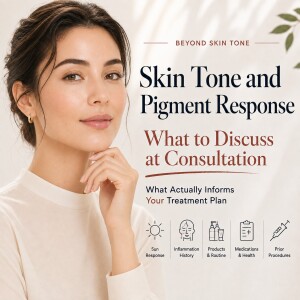
The Fitzpatrick scale comes up often in aesthetic consultations, and it is frequently misunderstood as a summary of who you are or what treatments you can have.
It was designed for something narrower: describing how skin responds to sun exposure.
This article explains what the scale was built to do, the limitations documented in the clinical literature, and what a clinician should be assessing alongside it.
It does not classify you, offer a skin-type quiz, or identify a best treatment — suitability is an individual clinical question.


INDEX
- What the Fitzpatrick Scale Was Designed to Describe
- Why It Is Not a Measure of Race, Ethnicity, or Treatment Suitability
- What Else a Clinician Should Assess
- Treatment Options You May Encounter in Japan
- How to Discuss Sun Response and Past Pigment Changes
- Questions to Ask if a Clinic Uses Skin-Type Categories
- Choosing a Clinic: English Communication and Transparent Case Information
- Consultation Checklist
- FAQs
What the Fitzpatrick Scale Was Designed to Describe
The scale was first described by Thomas B. Fitzpatrick in the early 1970s, and it was built around a specific question: how does a person’s skin react to sunlight?

Classification rested on how painful a sunburn tends to be and how much tanning develops afterward, following a defined period of midday sun exposure in northern latitudes 1.
Two details from that origin story are worth carrying into a consultation. First, the original scale covered four categories, and types V and VI were added later 1.
It was not designed from the outset to describe the full range of human skin. Second, it was built on self-reported experience — what a person remembers about how they burn and tan — rather than on a measurement 1.
Its intended use was practical rather than descriptive.
The classification has been used to help estimate ultraviolet dosing in phototherapy, to inform laser treatment planning, to consider skin cancer risk, and to guide sun protection counselling 1.
Those are dosing and risk-planning contexts, not questions about identity.
So when a clinician mentions it, the reasonable interpretation is: they are trying to gauge how your skin has historically reacted to sun. That is a legitimate piece of information. It is a small piece.
Why It Is Not a Measure of Race, Ethnicity, or Treatment Suitability
The clinical literature on the scale is explicit on this point: it was intended to reflect sun sensitivity, not to serve as a proxy for race or ethnic origin, and its color descriptors were meant to indicate complexion rather than self-identified background 1.
That distinction gets lost in practice, and the literature documents the consequences. Self-reported phenotype and race turn out to be incomplete predictors of where someone lands on the scale, and self-reporting itself is inconsistent — partly because burning and tanning mean different things to different people 1.
In at least one population-based study, the classification tracked with sun sensitivity in some groups and not in others 1.
The scale’s limitations in this respect are well enough recognized that separate classification systems have been developed for specific populations, and that objective measurement tools such as reflectance spectrophotometry have been explored as alternatives 1.
For you as a reader, the practical consequences are these. A Fitzpatrick category does not tell a clinician what treatment you should have.
It does not describe your medical history, your inflammatory conditions, your medications, or how you responded to a procedure two years ago.
And it is not a stand-in for your nationality or background, which are not clinical measures at all.
If a clinic reasons from a demographic label rather than from your history, that is not a shortcut to the same answer. It is a different and less informative question.
What Else a Clinician Should Assess
A useful assessment treats sun response as one line in a longer list.
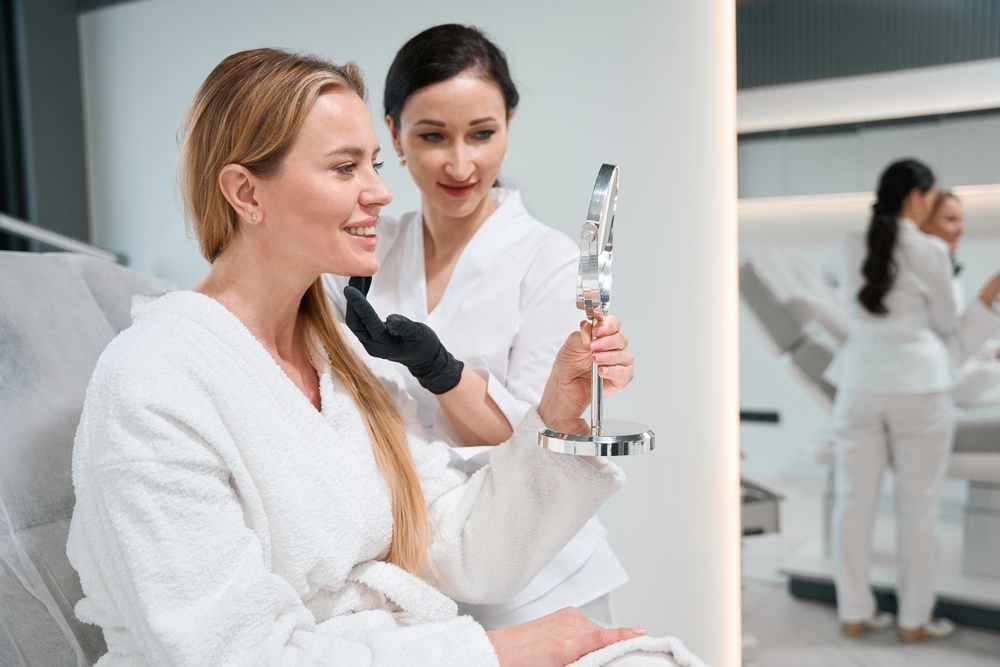
The rest of that list is largely history. How your skin has responded to inflammation — after acne, eczema, dermatitis, cuts, or friction — and whether marks were left behind, in which direction, and how long they took to settle.
Whether you have had pigment changes associated with pregnancy or hormonal medication. What you currently apply to your skin, including prescriptions, and what you have used recently. Medications you take, allergies, and relevant health history. Pregnancy or breastfeeding where applicable.
Then the present: what is visible and palpable now, where it is, whether there is active inflammation, and which areas are reactive or sensitive.
Then your circumstances: sun exposure in your daily life, upcoming travel, the season, and how much time you have in Japan for assessment, treatment, and observation.
Prior procedures deserve their own line. Category, approximate timing, how many sessions, and — most usefully — how your skin behaved afterward, including anything that took longer to settle than expected.
A specific concern will sometimes need its own conversation rather than being folded into a general plan; treatment considerations for melasma in Tokyo is one example of how a single pigment concern gets discussed in more depth.
Treatment Options You May Encounter in Japan
These categories come up frequently when sun response and pigment history are part of the discussion. They are listed so you recognize terminology, not as a menu and not in any order of preference.
Treatment availability, product and device status in Japan, clinician technique, treatment protocol, cost, recovery, and individual suitability can vary.
A product or device name alone does not determine whether an option is appropriate for you. Confirm current details directly with the treating clinic.
| What readers commonly want to discuss | Examples readers may encounter in Japan | Questions to ask in consultation | Travel / follow-up considerations |
| Uneven tone and pigmented areas | Laser and light-based treatments such as Pico laser; photofacial M22 | What in my history — not my category — informs how you would plan this? | How strictly must sun exposure be limited afterward, and for how long? |
| Texture and pore appearance | RF microneedling such as POTENZA; fractional approaches | What alternatives exist, including a more conservative approach? | What downtime falls inside my travel dates? |
| Surface renewal and dullness | Chemical peels, including glycolic acid or salicylic acid macrogol peels | How does this interact with my current products? | Can this be repeated or continued after I return home? |
| Reactive skin or a history of marks after inflammation | Any of the above, planned conservatively or staged | Which risks are material in my case, and how would they be recognized? | Who reviews my skin once I have left Japan? |
Post-procedure pigment change is a recognized topic in the clinical literature and a reasonable thing to raise directly 2.
Ask how it applies to your history rather than inferring it from a category you have been assigned.
How to Discuss Sun Response and Past Pigment Changes
Since sun response is what the scale was actually built to capture, you can give a clinician better information than a category number by describing it directly.
Useful things to be able to say:
- What happens after significant sun exposure. Whether you burn, tan, or both; how quickly; whether it is painful; and how long it takes to settle. If your answer is “it depends,” say what it depends on.
- How consistent your sun protection actually is, rather than what you intend. This changes the picture more than most people expect.
- Whether your concern looks different by season — and whether you are travelling somewhere with strong sun immediately after Japan.
- What marks have been left behind before. After acne, cuts, insect bites, or friction: did the area darken, lighten, or neither, and how long did it take to fade?
- Any pigment changes tied to pregnancy or hormonal medication, and whether they resolved.
- How previous procedures went, including anything that took longer to settle than you were told to expect.
Photographs help here, particularly unedited ones taken in natural light without make-up.
If your concern fluctuates, photographs from different points in the year are more informative than the single day you happen to be in the clinic.
If scarring rather than pigment is the main concern, the discussion runs differently and it helps to know that in advance; see what to expect when exploring acne-scar treatment options for how that conversation is usually framed.
Questions to Ask if a Clinic Uses Skin-Type Categories
Using the scale is not a red flag. Using it as the whole assessment is worth noticing.

Reasonable questions if it comes up:
- What are you using this classification for in my case?
- What else are you assessing alongside it?
- How did you arrive at it — from what I told you, from examining my skin, or from an assumption?
- What would change your plan regardless of where I fall on this scale?
- Are there aspects of my history that matter more here than the classification does?
A clinician who welcomes those questions is describing a process. A clinic that treats the number as the answer is describing a shortcut.
Neither response tells you anything about equipment, which is a separate comparison — a broader overview of laser treatment options in Tokyo covers what those categories address.
One thing to skip: online skin-type quizzes as preparation. Self-reporting is documented as inconsistent even within clinical settings 1, and arriving with a number you assigned yourself tends to narrow the conversation rather than open it. Bring your history instead.
Choosing a Clinic: English Communication and Transparent Case Information
If you decide to compare clinics, prioritize clinics that can explain your assessment, treatment alternatives, risks, written aftercare, and follow-up contact in English or through a qualified interpreter.
Ask whether they can show relevant case information transparently — including the treatment category, number of sessions, timing of photographs, expected downtime, and material risks — without presenting another person’s result as a guarantee of yours.
Case information rewards slow reading.
Check whether the treatment category and session count are stated, when photographs were taken relative to treatment, whether lighting, angle, and make-up are consistent, whether other procedures were performed at the same time, and whether downtime, risks, and individual variation are described.
Another person’s result is not evidence of what your skin will do — including when that person has been described as sharing your skin type.
| Questions to ask before choosing a clinic |
| 1. Who will explain my assessment, options, risks, and aftercare in English, and how will interpretation be handled if needed? |
| 2. How will you assess my current skin condition, previous reactions, medical history, and treatment goals? |
| 3. Which treatment categories are being considered, what alternatives exist, and why might you recommend waiting or choosing a different approach? |
| 4. Can you show relevant case information with the treatment category, number of sessions, photo timing, expected downtime, and material risks clearly stated? |
| 5. Will I receive written aftercare instructions in English and a way to contact the clinic after I leave Japan? |
| 6. What is included in the quoted cost, and are there any product, device, or regulatory details I should confirm for my plan? |
Consultation Checklist
Bring these questions with you:
- What are you assessing about my skin, and what role does sun response play in it?
- What in my personal history is most relevant to how you would plan this?
- Which risks are material in my case, and how would they be recognized early?
- What would make you postpone, stage, or change approach?
- What is uncertain here, and what would you want to observe?
- What restrictions apply afterward to sun exposure, make-up, and skincare, and for how long?
- What will be given to me in writing, and in English?
- How does follow-up work after I leave Japan, and who do I contact?
FAQs
Do I need to know my Fitzpatrick type before my appointment?
No. It is something a clinician can discuss with you during an assessment, and self-assigned categories are documented as unreliable.
Describing how your skin actually reacts to sun is more useful than arriving with a number.
Does a higher or lower number mean I can or cannot have a particular treatment?
No. The scale is one discussion tool within a broader assessment, not a rule about eligibility.
What determines an approach is your individual history, your current skin condition, and the clinician’s judgment.
Why do different sources place me in different categories?
Because the classification relies on subjective self-report, and terms like burning and tanning are interpreted differently by different people.
Inconsistency is a documented limitation of the scale rather than a mistake on your part.
Is the scale still used at all?
Yes, it remains in common clinical use for dosing and planning purposes, alongside recognized criticism of its limitations.
Ask what it is being used for in your case rather than treating it as either authoritative or meaningless.
References
- Sharma AN, Patel BC. Laser Fitzpatrick Skin Type Recommendations. StatPearls, NCBI Bookshelf
- Sowash M, Alster T. Review of Laser Treatments for Post-Inflammatory Hyperpigmentation in Skin of Color — PubMed
| ・This website provides general knowledge about aesthetic medicine from a neutral perspective as much as possible. Please note that the information is not intended to encourage self-diagnosis. Be sure to check the official website of the clinic and consult each medical institution for details regarding treatment. ・This article is based on information available at the time of writing and publication. Please check the official website for the latest updates. ・If cosmetics or massage-related content is mentioned, it is not within the scope of medical supervision. |