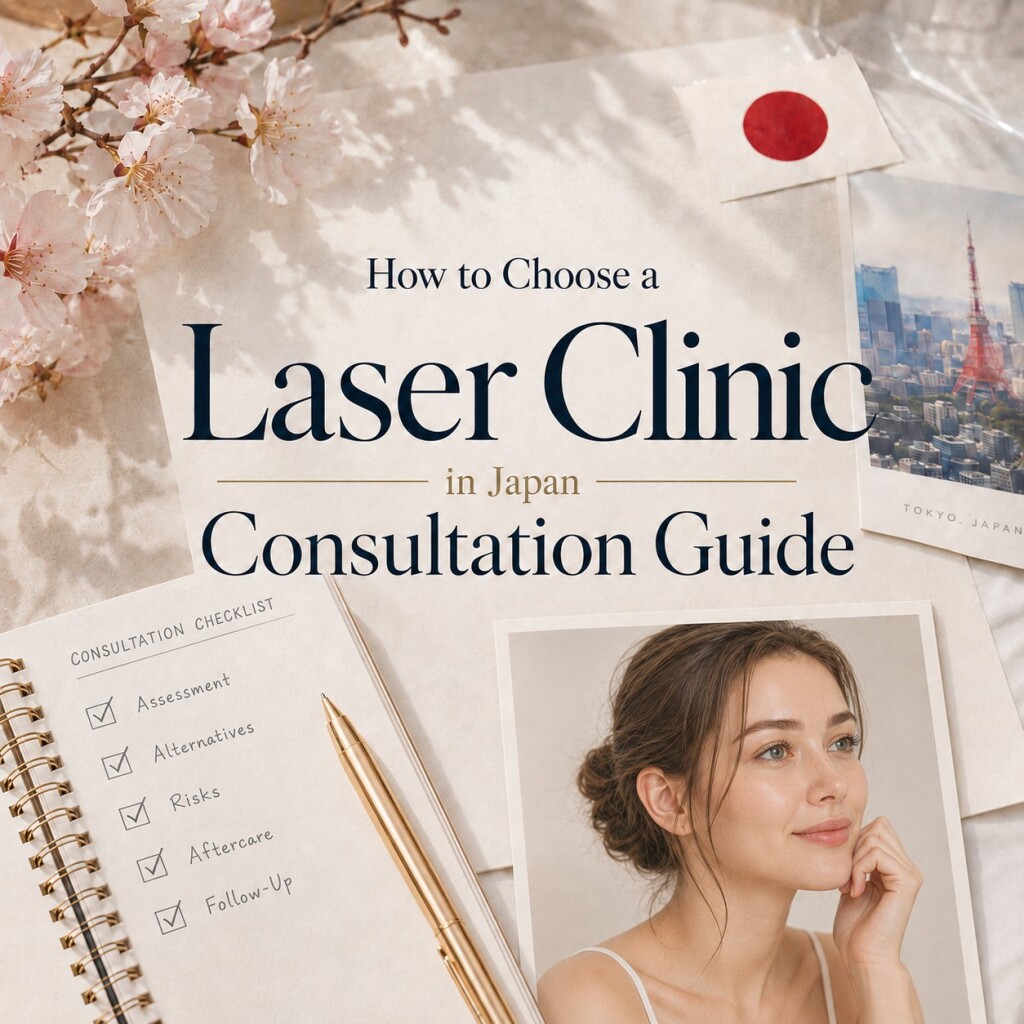
Most people comparing laser or light-based treatments in Japan start by comparing device names.
That is the part clinics advertise, and it is the part that is easiest to search. It is also the part that tells you least about the care you will receive.
This article looks at what to compare instead: how a clinic assesses you, how it explains alternatives and risks, what it puts in writing, and how follow-up works if you are visiting.
There is no universal best device or clinic, and suitability is an individual clinical question.


INDEX
- Why a Device Name Alone Is Not Enough
- Treatment Options You May Encounter in Japan
- What to Ask About Your Personal Skin Assessment
- Questions About Treatment Rationale and Expected Trade-Offs
- When a Test Spot or Staged Plan May Be Discussed
- Aftercare, Follow-Up, and Communication if You Are Visiting Japan
- Choosing a Clinic: English Communication and Transparent Case Information
- How to Compare Answers From Different Clinics
- Consultation Checklist
- FAQs
Why a Device Name Alone Is Not Enough
A device is a tool.
What determines whether a treatment is appropriate for you is the assessment behind it, the settings and technique chosen by the clinician, the treatment plan, and how the result is monitored afterward. None of that is visible in a brand name.
The same device can be used differently by different clinicians.
Two clinics may list an identical machine and describe it in identical marketing language while running very different consultations — one that examines your history in detail and one that essentially confirms the booking you already made online.
That difference is the one that affects your outcome, and it is not on the price list.
Device names also drift in meaning as they travel between markets.
A term you encountered in another country may refer to a different generation of equipment, a different treatment protocol, or a different category of use in Japan. Availability, regulatory status, and how a clinic applies a given technology all vary.
There is a practical version of this problem: if you arrive asking for a specific device, the consultation tends to become a discussion about whether you can have it, rather than whether it is the reasonable option for your skin.
Arriving with a concern instead of a product name keeps the alternatives on the table.
If you want a general sense of what these categories address before you compare clinics, read an overview of laser treatment options for pigmentation, pores, and acne scars first, then come back to the clinic comparison.
Treatment Options You May Encounter in Japan
The categories below appear frequently when texture, pigment, and scarring concerns are discussed. They are here so you recognize terminology during a consultation, not as a menu to select from and not in any order of preference.
Treatment availability, product and device status in Japan, clinician technique, treatment protocol, cost, recovery, and individual suitability can vary.
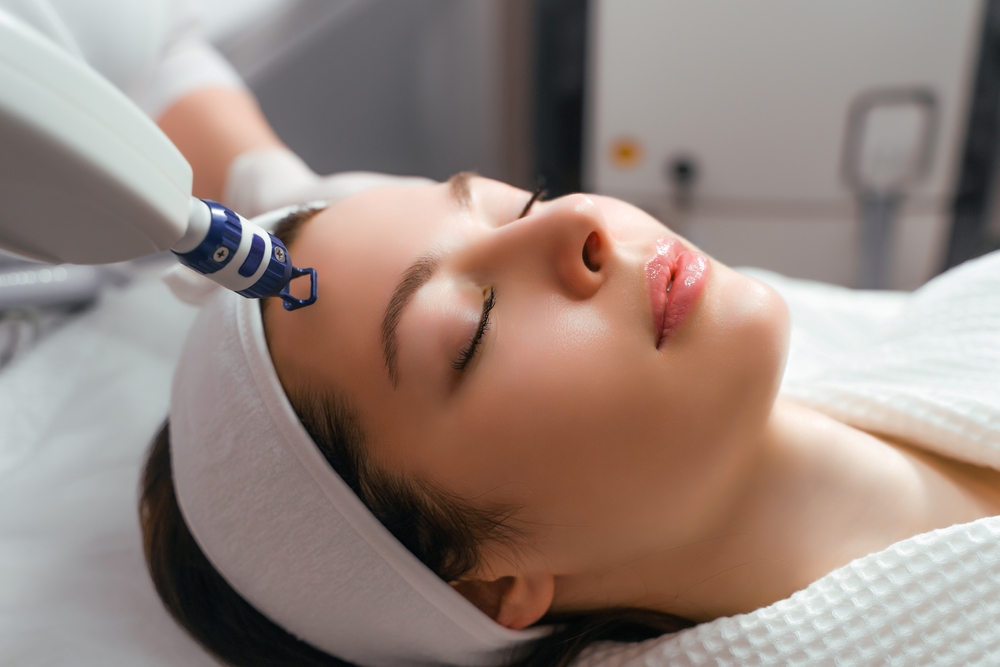
A product or device name alone does not determine whether an option is appropriate for you. Confirm current details directly with the treating clinic.
| What readers commonly want to discuss | Examples readers may encounter in Japan | Questions to ask in consultation | Travel / follow-up considerations |
| Pigmented areas and uneven tone | Pico laser; Q-switched ruby laser; photofacial M22 | Why this category rather than another, and what pigment-related risks apply to me? | How long until sun exposure and make-up are unrestricted? |
| Pore appearance and textural irregularity | Fractional laser approaches; RF microneedling such as POTENZA or Morpheus8 | How many sessions are usually discussed, and what does one session address? | Is redness or swelling expected on the days I am traveling? |
| Acne scarring and surface irregularity | CO₂ laser; fractional resurfacing; RF microneedling | What alternatives exist, including doing nothing for now? | What observation period would you want before I fly? |
| Overall dullness and surface renewal | Chemical peels such as glycolic acid or salicylic acid macrogol peels | How does this interact with my current products? | Can this be continued or repeated at home? |
| Reactive or easily irritated skin | Any of the above, planned conservatively or staged | What would make you postpone or change approach? | Who do I contact if something is unexpected after I leave? |
Pigment change following inflammation or a procedure is an established clinical topic and one worth raising explicitly, particularly if you have noticed marks lingering after spots, injuries, or previous treatments 1.
Ask how it applies in your case rather than assuming it does or does not.
What to Ask About Your Personal Skin Assessment
The assessment is where the clinical thinking happens, so it is fair to ask what it will involve before you commit to an appointment.
A thorough assessment generally covers what is visible and palpable now — texture, oil and dryness, active inflammation, existing marks — alongside your history and circumstances.
History means how your skin has responded previously: to sun, to inflammation such as acne or eczema, to prior procedures, and to prescription or over-the-counter products.
Circumstances mean medications, relevant health history, allergies, pregnancy or breastfeeding where applicable, your actual routine, and your travel schedule.
You may encounter the Fitzpatrick scale in this conversation. It can serve as one discussion tool among several, but it is not a measure of race, ethnicity, or nationality, and it does not by itself determine whether a treatment suits you 2.
If a clinic leans on it heavily, ask what else is being assessed alongside it.
Ask who performs the assessment and who performs the treatment. Ask whether the person examining your skin is the person who will set the parameters on the day.
If a nurse, counsellor, or coordinator handles the initial discussion, ask at what point a physician is involved and what they review.
Concerns that look cosmetic sometimes are not. If you have a lesion that has changed in size, shape, color, or sensation, ask for it to be evaluated clinically before any aesthetic plan is discussed.
For a worked example of how one common pigment concern is approached in consultation, see what to expect when discussing melasma treatment in Tokyo.
Questions About Treatment Rationale and Expected Trade-Offs
Every option carries trade-offs. A consultation that describes only upside is incomplete, regardless of how the clinic presents itself.
Ask why this category rather than another, and what specifically about your skin points that way.
Ask what the alternatives are, including more conservative approaches and waiting. Ask what would make the clinician change course — that answer reveals whether there is a plan or a default.

Ask about trade-offs in concrete terms: what is felt during and after, what is visible afterward and for how long, what restrictions apply to sun exposure, make-up, exercise, and skincare, and what the realistic range of response is rather than the ideal case.
Ask which risks are material for you, how they would be recognized, and how they would be managed.
Ask what happens if the response is less than hoped for, or uneven.
Ask whether additional sessions are included, discounted, or charged in full, and get that answer before the first appointment rather than after it.
Ask what proportion of the plan needs to happen while you are in Japan.
If any of these questions produce a reassurance rather than an answer, note it. Reassurance is not information, and you are comparing information.
When a Test Spot or Staged Plan May Be Discussed
Some clinicians discuss treating a small area first, or beginning with conservative settings and building across sessions.
Whether either is relevant is a clinical judgment, not a step every reader needs, and it is not something to request as a default.
What is useful to understand is what such an approach is and is not intended to do.
It is generally discussed as one way to observe how skin responds under specific conditions on a specific day.
It does not guarantee that a fuller treatment will produce the same response, does not remove risk, and cannot predict how your skin behaves months later or in a different season.
Practical questions if it comes up: how long would you need to wait before the main treatment, what exactly is being watched for, what result would change the plan, and does that waiting period fit inside your stay.
For a visitor, the answer to the last question sometimes determines the whole schedule — a staged approach that requires two weeks of observation is not compatible with a five-day trip, and that is worth knowing before you arrive rather than at the consultation.
Aftercare, Follow-Up, and Communication if You Are Visiting Japan
Aftercare is where language support most often breaks down, because it happens when you are no longer in the room.
Ask for written aftercare instructions in English, and check what they cover: sun protection, cleansing, what to apply and what to avoid, make-up timing, exercise, what is expected day by day, and what would be outside the expected range.
Verbal instructions delivered through an interpreter at the end of a long appointment are easy to lose.
Ask how the clinic can be reached after you leave the country — by email, by messaging, in English or through interpretation — and what response time is realistic. Ask who to contact if something concerning happens at 2am in another timezone, and what they would advise you to do locally in that case.
If symptoms are painful, worsening, or otherwise concerning, appropriate clinical assessment where you are should not wait for a reply from abroad.
Ask about timing in both directions: how soon before your flight a treatment can reasonably happen, and how much observation time the clinician would prefer you have in Japan.
Ask what is included in the quoted price — consultation, treatment, aftercare products, follow-up visits — and what is billed separately. Ask whether a follow-up appointment is expected within your stay and, if so, build the itinerary around it rather than the reverse.
If English communication is a priority for you, it is worth checking arrangements before booking rather than assuming; how to find and book an English-speaking dermatologist in Tokyo covers the practical side of that search.
Choosing a Clinic: English Communication and Transparent Case Information
If you decide to compare clinics, prioritize clinics that can explain your assessment, treatment alternatives, risks, written aftercare, and follow-up contact in English or through a qualified interpreter.
Ask whether they can show relevant case information transparently — including the treatment category, number of sessions, timing of photographs, expected downtime, and material risks — without presenting another person’s result as a guarantee of yours.
When you look at case information, check whether the treatment category and session count are stated, when photographs were taken relative to treatment, whether lighting, angle, and make-up are consistent, whether other procedures were performed at the same time, and whether downtime, risks, and individual variation are described.
Another person’s result is not evidence of what your skin will do. How a clinic presents that information tells you something about how it will communicate with you.
| Questions to ask before choosing a clinic |
| 1. Who will explain my assessment, options, risks, and aftercare in English, and how will interpretation be handled if needed? |
| 2. How will you assess my current skin condition, previous reactions, medical history, and treatment goals? |
| 3. Which treatment categories are being considered, what alternatives exist, and why might you recommend waiting or choosing a different approach? |
| 4. Can you show relevant case information with the treatment category, number of sessions, photo timing, expected downtime, and material risks clearly stated? |
| 5. Will I receive written aftercare instructions in English and a way to contact the clinic after I leave Japan? |
| 6. What is included in the quoted cost, and are there any product, device, or regulatory details I should confirm for my plan? |
How to Compare Answers From Different Clinics
Comparing consultations works better with notes than with memory. Ask the same questions at each clinic and write the answers down the same day, while the differences are still clear.
Notice pressure as data. Time-limited pricing, packages presented before an examination, and reluctance to put the plan in writing are all communication signals worth weighing.

What separates one consultation from another is rarely the equipment list.
It is whether your skin was described specifically or generically, whether alternatives were raised unprompted, whether anything was written down, and whether the plan changed at all in response to what you said.
Differences in recommendation between clinics are normal and are not proof that one is wrong. Where they diverge sharply, ask each clinician to explain the reasoning — the explanation is usually more informative than the recommendation.
Consultation Checklist
Take these to each clinic you compare:
- How would you describe what you are seeing in my skin, and what did you examine to reach that?
- Which treatment categories are you considering for me, and what are the alternatives, including waiting?
- Which risks are material in my case, and how would they be recognized and managed?
- Who performs the treatment, and who decides the settings on the day?
- How many sessions are usually discussed, and what does one session realistically address?
- What restrictions apply afterward to sun exposure, make-up, exercise, and skincare, and for how long?
- Will I receive written aftercare in English, and how do I reach you after I leave Japan?
- What is included in the quoted price, and what would additional sessions cost?
FAQs
Is a newer device better than an older one?
Not inherently. Suitability depends on your assessment, the clinician’s technique and protocol, and the plan for follow-up.
A device generation tells you about equipment, not about whether an approach fits your skin.
Should I book a treatment on the same day as the consultation?
That depends on the clinician’s judgment and on your schedule. Some prefer to assess first and treat later, and a schedule that leaves no room for that reduces your options.
Ask in advance whether same-day treatment is expected and whether it is avoidable.
How many clinics should I compare?
There is no set number. Two or three consultations usually make differences in assessment quality visible, which is the point of comparing.
More consultations add cost and time without necessarily adding clarity.
What if two clinics recommend completely different approaches?
Ask each to explain why, in terms of your skin specifically.
Reasonable clinicians can differ. If one explanation is detailed and the other is not, that difference is itself informative.
References
| ・This website provides general knowledge about aesthetic medicine from a neutral perspective as much as possible. Please note that the information is not intended to encourage self-diagnosis. Be sure to check the official website of the clinic and consult each medical institution for details regarding treatment. ・This article is based on information available at the time of writing and publication. Please check the official website for the latest updates. ・If cosmetics or massage-related content is mentioned, it is not within the scope of medical supervision. |