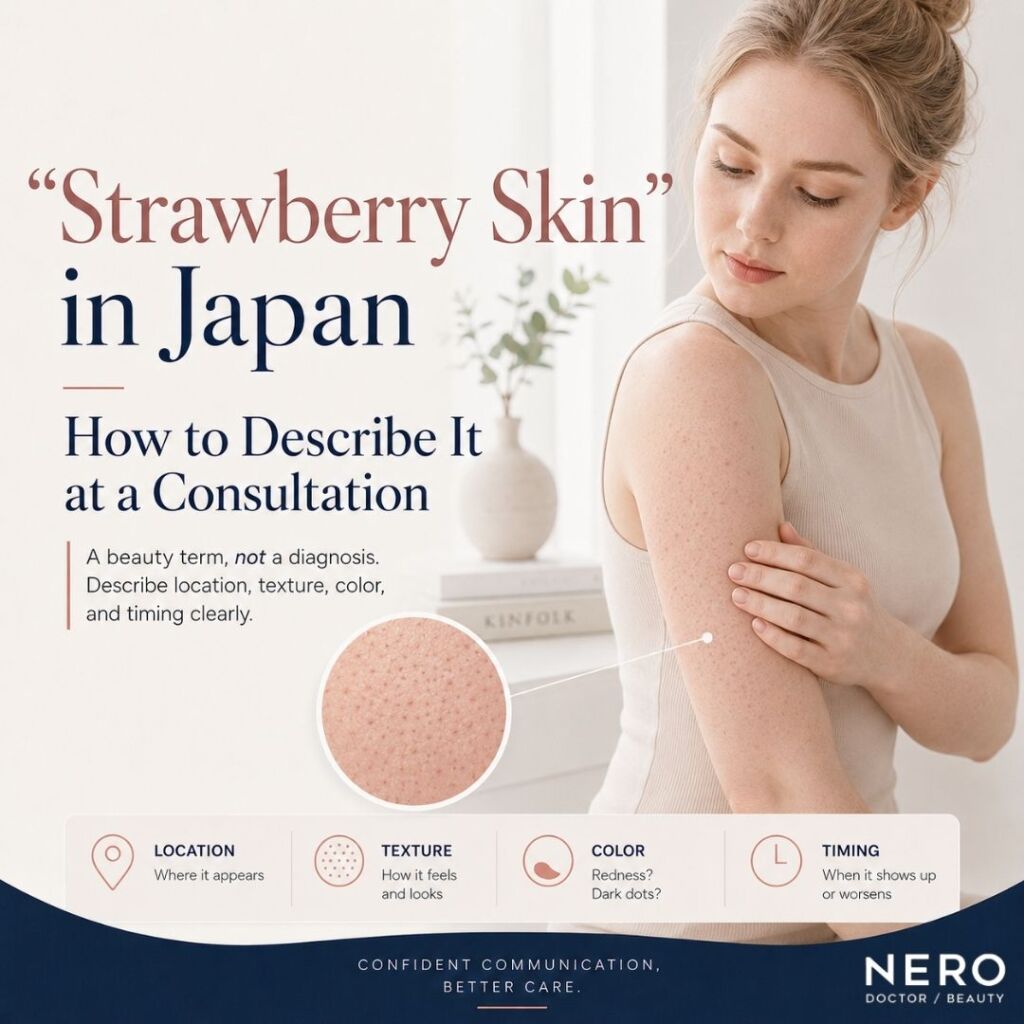
“Strawberry skin” is a description that travels through beauty media, not a diagnosis.
People use it for several different things, on different parts of the body, with different underlying explanations — which is why arriving at a consultation with the phrase alone tends to produce a guess rather than an assessment.
This article helps you describe what you are actually seeing: where it is, what it looks and feels like, when it changes, and what you have already tried. It does not diagnose, name a cause, or identify a treatment.


INDEX
- Why “Strawberry Skin” Can Mean Different Things
- What to Notice Before Your Appointment
- Treatment Options You May Encounter in Japan
- How to Describe Location, Texture, Color, and Timing
- Questions to Ask Before Comparing Treatments
- Choosing a Clinic: English Communication and Transparent Case Information
- When Medical Assessment Should Come First
- FAQs
Why “Strawberry Skin” Can Mean Different Things
The term is visual and borrowed. It describes an impression — small dark or raised points across an area of skin — rather than anything a clinician could act on directly.
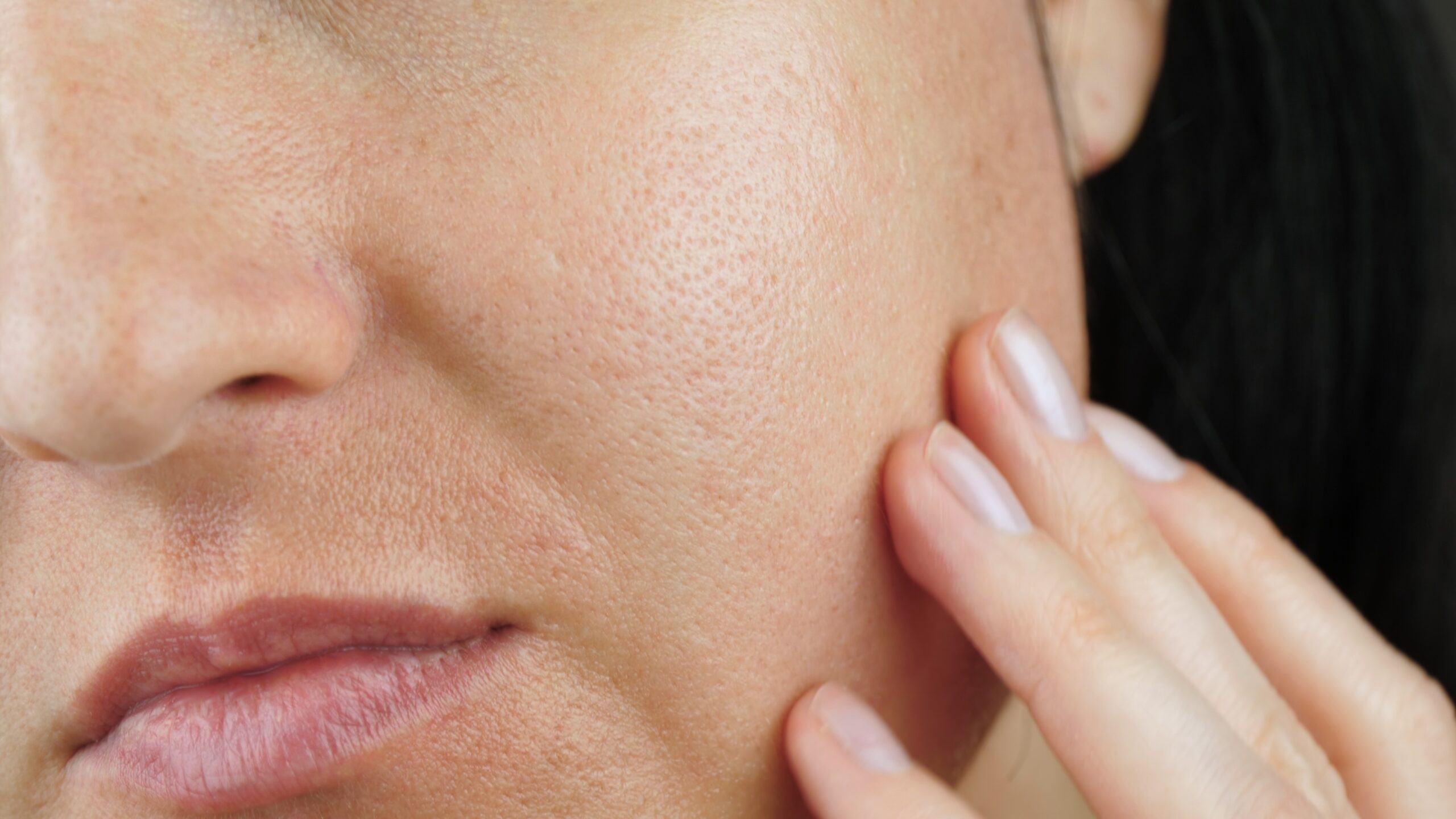
In practice, people use it for quite different things. Some mean the appearance of pores on the nose and cheeks. Others mean the legs after hair removal, where follicles look darker or the surface feels rough.
Some mean small bumps that have been there since childhood; others mean something that appeared last year. Some are describing color, some texture, some both.
Those descriptions can have entirely different explanations, and several unrelated things can produce a broadly similar appearance.
That is precisely why the term is not useful as a starting point in a clinical setting.
A clinician who accepts it at face value and moves straight to a treatment menu has skipped the part that matters.
There is a second problem worth naming. Because the phrase circulates through social media, the images attached to it are usually filtered, lit deliberately, and photographed at close range.
Skin at that magnification looks different from skin at conversational distance, and comparing yourself to a macro photograph sets a reference point that is not about health or treatment at all.
If pore appearance on the face is what you are describing, an overview of pores and skin-texture treatment options in Tokyo covers the categories usually discussed and will save consultation time.
What to Notice Before Your Appointment
Spend a week paying attention before you go. Observation collected over several days is more informative than whatever is visible on the morning of the appointment.
Worth noticing:
- Where it is. Which areas exactly, whether it is symmetrical, and whether other areas are unaffected.
- What changes it. Time of day, temperature, humidity, exercise, shaving or waxing, clothing, sun exposure, menstrual cycle where relevant, and season.
- How long it has been there. Whether it appeared, gradually developed, or has always been present.
- Whether it is stable. Getting worse, getting better, fluctuating, or unchanged.
- What it feels like. Rough, smooth, raised, tender, itchy, or nothing at all.
- What you have tried. Products, exfoliation, hair-removal methods, and whether anything helped, made no difference, or made it worse.
Take photographs across those days: natural indirect light, no make-up, no filters, same distance and angle, at normal viewing distance rather than macro.
A clinician gains more from a consistent series than from one close-up.
If breakouts are part of what you are seeing, that changes the shape of the conversation and is worth reading up on separately — guidance on acne treatment options for international patients sets out how those consultations usually run.
Treatment Options You May Encounter in Japan
These categories come up when texture and pore appearance are discussed. They are listed so you recognize terminology in a consultation — not as a menu, not as a response to anything described above, and not in any order of preference.

What is appropriate depends on an assessment that has not happened yet.
Treatment availability, product and device status in Japan, clinician technique, treatment protocol, cost, recovery, and individual suitability can vary.
A product or device name alone does not determine whether an option is appropriate for you. Confirm current details directly with the treating clinic.
| What readers commonly want to discuss | Examples readers may encounter in Japan | Questions to ask in consultation | Travel / follow-up considerations |
|---|---|---|---|
| Pore appearance on the face | Pore cleansing approaches such as HydraFacial; chemical peels, including glycolic acid or salicylic acid macrogol peels | What are you actually seeing, and what does that suggest about the approach? | How soon can I wear make-up or be in strong sun? |
| Surface roughness and texture | RF microneedling such as POTENZA; microneedling approaches such as Dermapen | What alternatives exist, including doing nothing for now? | What is visible on the days I am travelling? |
| Textural irregularity with marks | Pico fractional laser; other laser and light-based approaches | Which risks are material given my history of marks after inflammation? | What sun restrictions apply, and for how long? |
| Roughness on the body or legs | Surface renewal approaches; clinician-led topical plans | Should this be assessed medically before any aesthetic option is considered? | Can anything be continued after I return home? |
| Ongoing home care | Clinician-supervised topical plans | How does this interact with the products I already use? | Is it available where I live? |
If inflammation has left marks behind for you before — after spots, ingrown hairs, or irritation — that history is relevant here and is an established consideration in treatment planning 1. Raise it rather than waiting to be asked.
How to Describe Location, Texture, Color, and Timing
This is the part that converts a beauty term into clinical information. You do not need medical vocabulary; plain description is what is wanted.

Location
Be specific. Not “my legs” but which parts, whether both sides are the same, and whether the same appearance shows up anywhere else on your body.
Texture
Run your fingers over it with your eyes closed. Is the surface raised, flat, rough, or smooth? Can you feel the points you can see, or only see them? Does it feel different from the skin next to it?
Color
What color are the points — darker, redder, the same as your skin, or lighter? Is the surrounding skin a different color? Does the color change after heat, exercise, or hair removal?
Timing
When did it start, what was happening in your life around then, and does it follow any cycle. If it varies, say what it varies with.
Sensation
Whether there is itching, tenderness, burning, or nothing.
What you have done about it.
Hair-removal methods and how often, exfoliation, products used on the area, and how the skin responded to each.
Photograph the labels of anything you currently apply, including prescriptions; brand names differ between countries.
Bring this written down in English, along with your photograph series. At an appointment running through an interpreter, a prepared page carries more detail than an on-the-spot description.
Questions to Ask Before Comparing Treatments
Before comparing options, get the clinician’s read on what they are seeing.
A treatment discussion that begins before that step is a discussion about their menu, not your skin.
Reading about a specific approach beforehand can help you tell those two conversations apart — HydraFacial benefits and treatment expectations in Tokyo is one example of the kind of background worth having in advance.
| Questions to bring to your consultation |
|---|
| 1. How would you describe what you are seeing, in your own words rather than mine? |
| 2. What did you examine to reach that description, and what remains uncertain? |
| 3. Should anything be assessed medically before an aesthetic option is considered? |
| 4. Which categories are you considering, what are the alternatives, and what happens if I do nothing for now? |
| 5. Which risks are material for me, given my history of how skin marks or reacts? |
| 6. How many sessions are usually discussed, and what does one session realistically address? |
| 7. What restrictions apply afterward, and how do they fit my travel dates? |
| 8. What is included in the quoted price, and what would further sessions cost? |
If the answer to the first question is a repetition of the phrase you brought in, that is worth noting. So is a recommendation offered before anything has been examined.
Choosing a Clinic: English Communication and Transparent Case Information
If you decide to compare clinics, prioritize clinics that can explain your assessment, treatment alternatives, risks, written aftercare, and follow-up contact in English or through a qualified interpreter.
Ask whether they can show relevant case information transparently — including the treatment category, number of sessions, timing of photographs, expected downtime, and material risks — without presenting another person’s result as a guarantee of yours.
Case information on texture and pore concerns deserves particular scrutiny, because appearance here is unusually sensitive to how a photograph is taken.
Check whether the treatment category and session count are stated, when photographs were taken relative to treatment, whether lighting, angle, distance, and make-up are consistent between images, whether other procedures were performed at the same time, and whether downtime, risks, and individual variation are described.
Two photographs of the same unchanged skin can look entirely different under different lighting. Another person’s result is not evidence of what your skin will do.
| Questions to ask before choosing a clinic |
|---|
| 1. Who will explain my assessment, options, risks, and aftercare in English, and how will interpretation be handled if needed? |
| 2. How will you assess my current skin condition, previous reactions, medical history, and treatment goals? |
| 3. Which treatment categories are being considered, what alternatives exist, and why might you recommend waiting or choosing a different approach? |
| 4. Can you show relevant case information with the treatment category, number of sessions, photo timing, expected downtime, and material risks clearly stated? |
| 5. Will I receive written aftercare instructions in English and a way to contact the clinic after I leave Japan? |
| 6. What is included in the quoted cost, and are there any product, device, or regulatory details I should confirm for my plan? |
When Medical Assessment Should Come First
Some of what gets called “strawberry skin” is a cosmetic concern.
Some of it is not, and the two are not reliably distinguishable from a photograph or an article.
Anything that is painful, itchy, spreading, bleeding, discharging, changing in size, shape, or color, or simply not settling is a reason for clinical assessment before any aesthetic plan is discussed.
The same applies if a single area behaves differently from everything around it. This is not a matter of severity — it is that an aesthetic consultation is not designed to answer that question, and starting a treatment plan on top of an unassessed condition makes both harder to sort out.
If you are unsure which situation you are in, say so at the beginning of the appointment.
Asking whether something should be looked at medically first is a reasonable question, and a clinic that treats it as an obstacle has answered a different question for you.
Where a clinic offers both dermatological and aesthetic services, ask who is doing the assessing and what their qualification is. Where it does not, ask whether they would refer you and to whom.
FAQs
Is “strawberry skin” a medical condition?
No. It is a descriptive beauty term used for several different appearances with different explanations. What you are seeing needs to be assessed on its own terms rather than through the label.
Can it be treated in one session while I am in Japan?
That depends on what it turns out to be, which is not knowable in advance.
Ask at the consultation what a single session would realistically address and whether a plan requires appointments you cannot fit in.
Should I stop shaving or exfoliating before my appointment?
Ask the clinic rather than changing your routine based on general advice — and mention what you normally do and when you last did it, since that context is part of what is being assessed.
Why do clinics describe this differently from each other?
Because the term has no fixed clinical meaning, so each clinician is interpreting what they see.
Where descriptions diverge, ask each to explain their reasoning; the explanation is more informative than the label.
References
| ・This website provides general knowledge about aesthetic medicine from a neutral perspective as much as possible. Please note that the information is not intended to encourage self-diagnosis. Be sure to check the official website of the clinic and consult each medical institution for details regarding treatment. ・This article is based on information available at the time of writing and publication. Please check the official website for the latest updates. ・If cosmetics or massage-related content is mentioned, it is not within the scope of medical supervision. |