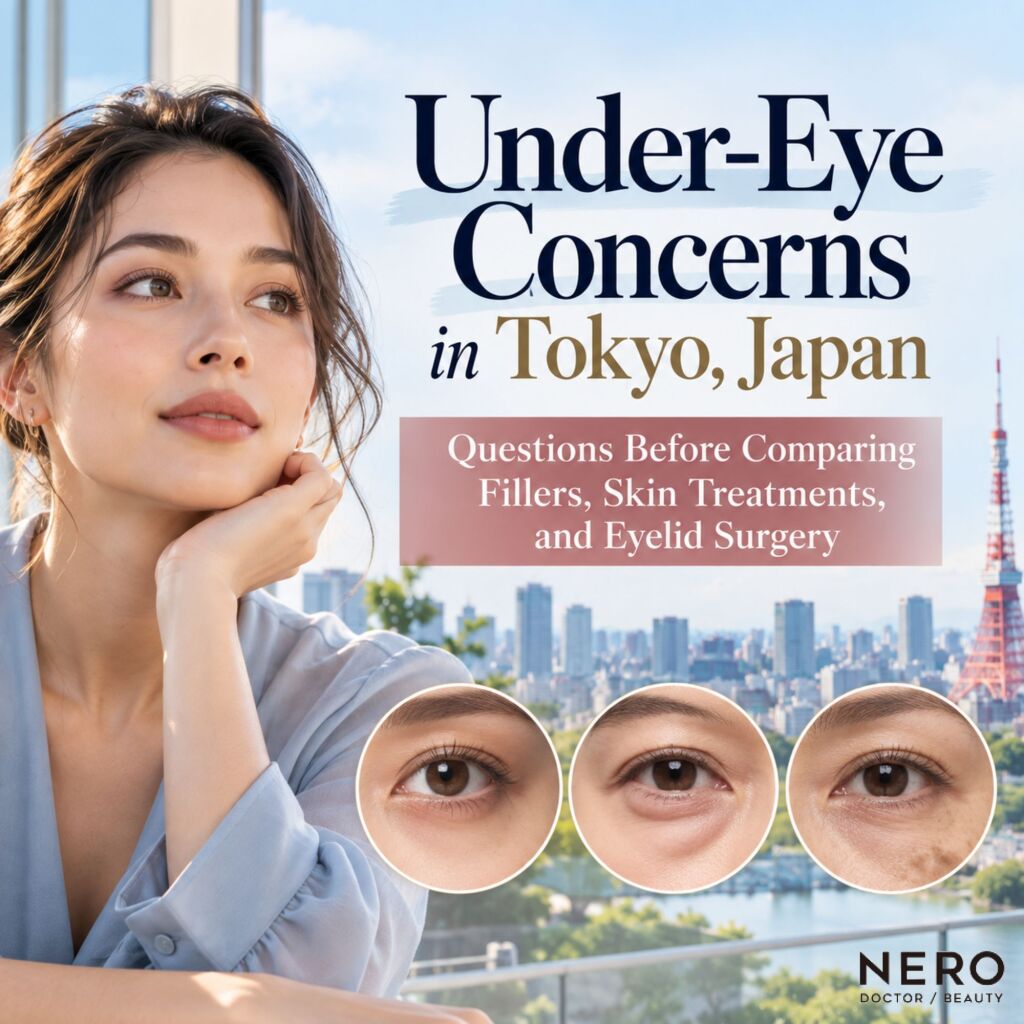
There is no default answer for the under-eye area.
Hollowing, shadowing, puffiness, skin texture and eyelid shape can look similar and lead to different discussions, and fillers, skin-focused treatments and eyelid surgery are not ranked alternatives to one another.
Describe what you see before naming a procedure.
Then compare each proposal on its stated goal, what it is not expected to change, invasiveness, visible recovery, written terms and follow-up after you leave Japan.


The Short Answer: Compare the Concern Before the Treatment
The under-eye area attracts more procedure names per square centimetre than almost any other part of the face, which is why so many readers arrive having already narrowed the question to a choice between two of them.
That narrowing usually happens before the concern itself has been described.
Why Under-Eye Concerns Do Not Have One Default Answer
What a person calls “tired eyes” may involve the contour beneath the eye, the skin itself, the shape of the lower lid, the surrounding tissue, or several of these at once.
Because the contributing factors differ between individuals, there is no procedure that is the standard answer for the area, and no ordering of the pathways that holds for everyone.
Two clinicians may reasonably propose different things for the same described concern.
What a Qualified Assessment May Need to Clarify
An in-person assessment is where the question of what is producing the appearance gets addressed.
That is not something a photograph, an article or a search summary can establish, and it is the step that determines whether any of the pathways below is relevant to you.
Ask what the clinician observed and how it relates to what you described — the answer is the foundation of everything that follows.
Your Next Comparison Task
Your task before a consultation is narrower than choosing a treatment.
It is to describe the concern clearly, to prepare the same questions for every clinic, and to decide what you expect to receive in writing.
If you are still mapping which concerns and pathways exist across the face, Aesthetic Concerns in Japan covers that ground before any procedure name enters the conversation.
Name the Concern Before You Compare Options
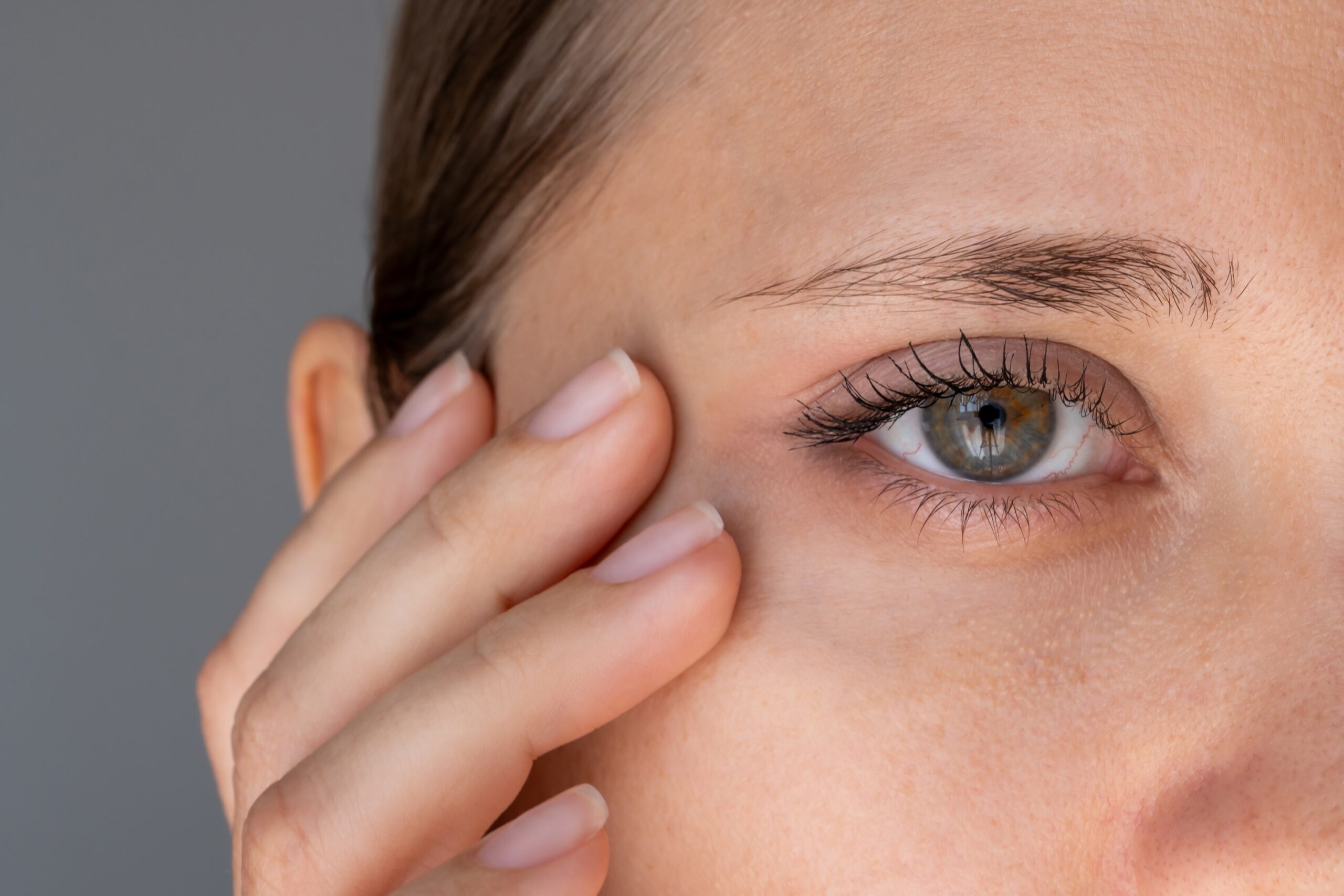
The vocabulary in this area is loose in ordinary use and specific in clinical use, and the gap between the two causes a lot of avoidable confusion in consultations.
Hollowing, Shadowing, Puffiness, and Skin Texture
These four describe different observations.
Hollowing refers to a contour that appears recessed.
Shadowing refers to darkness that may or may not correspond to a contour.
Puffiness refers to fullness or swelling in the area.
Skin texture refers to the surface itself — fine lines, crepiness, laxity.
You may see more than one, and they may be related; what matters is that you report which you see rather than choosing a single word for all of it.
Lower-Eyelid Shape and Tear-Trough Terminology
“Tear trough” is an anatomical term that has become a treatment-marketing term, which means it now carries both a specific meaning and a vague one.
Lower-eyelid shape and position are separate considerations again.
If a clinic uses either term, it is worth asking what they mean by it in your case rather than assuming the definition you read online is the one being applied.
How Lighting, Makeup, and Photos Can Change What You See
Overhead lighting deepens shadow under the eye; front lighting flattens it.
Makeup, tiredness, sleep position, fluid balance and time of day can all change the appearance from hour to hour.
This is why a clinician may ask when it looks worst, and why photographs taken in consistent ordinary light over time are more informative than a single image taken on a difficult morning.
If you are also looking at clinic photographs, How to Read Before-and-After Photos in Aesthetic Medicine explains which conditions make an image comparable to your own situation.
Understand the Three Treatment Pathways
These three are presented as separate planning pathways, not as options in rank order.
Which, if any, is relevant is a clinical question, and it is not settled by anything in this section.
Where Under-Eye Fillers Fit in a Comparison
Filler is an injectable pathway, discussed in relation to contour.
As a category it raises its own set of questions: what product, what is being addressed, how many appointments, what happens as the material changes over time, what the options are if you are unhappy with the result, and what the review arrangements are.
Because it is often the first pathway readers encounter, it is also the one most likely to be chosen before the concern is described.
Tear Trough Fillers in Japan covers this pathway in more detail.
Where Skin-Focused Treatments Fit in a Comparison
Skin-focused treatments address the surface and quality of the skin rather than contour or lid structure.
They belong in the comparison when what you described includes texture, fine lines or laxity.
They may be discussed on their own, alongside another pathway, or in a sequence.
As with the others, the useful questions are what the proposal targets, what it is not expected to change, how many sessions are involved, and over what period.
When Eyelid Surgery Becomes a Separate Planning Pathway
Eyelid surgery is a surgical pathway and is planned differently from the other two:
the consultation, the consent process, the recovery discussion and the follow-up arrangements are all more involved, and the travel implications are substantially different for a visitor.
It is not “the stronger option” and not a last resort — it is a separate conversation with its own questions.
Blepharoplasty in Japan covers what that planning involves for international patients.
Set the Boundaries of a Fair Comparison
A comparison is only as good as the axes it uses.
Comparing procedures directly against one another produces a false contest; comparing each proposal against your stated concern produces something usable.
Compare the Goal Before Comparing a Procedure
Ask each clinician to state what their proposal is intended to address, in relation to what you described.
Two proposals aimed at different aspects of the same appearance are not competing — they are answering different questions, and you may end up needing to decide which question matters more to you rather than which procedure is preferable.
Ask What Each Pathway May Not Change
This question gets asked far less often than it should.
A proposal that addresses contour may not affect skin surface; one that addresses skin may not affect shadow; none of them addresses everything.
Recording what each pathway is not expected to change is often more clarifying than recording what it is.
Separate Invasiveness, Visible Recovery, and Follow-Up
These three travel together in most people’s minds and should be separated on paper.
Invasiveness is about what the procedure involves.
Visible recovery is about appearance afterwards, described as a range with conditions rather than a fixed period.
Follow-up is about review, contact and what happens if something needs attention.
A pathway can differ from another on one of these and not the others.
Do Not Treat Before-and-After Images as a Personal Forecast
Images show what happened for a particular person under particular conditions, photographed in a particular way.
They can be useful for understanding what a clinic is aiming at and for showing a clinician what you have in mind.
They are not a prediction of your result, and treating them as one is the most common way a comparison goes wrong in this area.
Decision Aid: Build a Two-Consultation Comparison Record

This record produces no ranking and no recommendation.
Its purpose is to capture the same fields at both consultations so that the difference between two proposals is visible in writing rather than reconstructed from memory a week later.
| Field to record | What a useful entry in this row looks like | Consultation A | Consultation B |
| Your concern statement | The identical sentence used at both clinics, describing what you see | ||
| When it looks most noticeable | Time of day, lighting, or circumstances you reported | ||
| Relevant history you shared | Previous treatments in the area, products, and any reactions | ||
| What the clinician observed | What you were told is visible on assessment, in their words | ||
| Pathway proposed | Filler, skin-focused treatment, eyelid surgery, or a combination | ||
| Stated goal of the proposal | What it is intended to address, in relation to your concern statement | ||
| What it is not expected to change | Named explicitly, not inferred by you | ||
| Alternatives discussed | Other pathways raised for the same concern, including waiting | ||
| Product, technique or procedure named | Recorded separately from the pathway | ||
| Invasiveness, as described | What the appointment or procedure involves, in the clinician’s words | ||
| Visible recovery, as described | A range with conditions attached — not a date you converted it into | ||
| Review and follow-up | Whether a review is expected, when, and what it would involve | ||
| If you were unhappy with the result | What options were described, and over what timeframe | ||
| Language support | What was spoken, what was interpreted, and what was written | ||
| What you received in writing | The documents actually handed to you, not what you were told would follow | ||
| Travel implications | What the proposal assumes about your dates, and what it would require after you leave | ||
| Questions still open | Anything unanswered, or that occurred to you afterwards |
Write the Same Concern Statement for Both Consultations
Prepare one sentence and use it verbatim at both clinics.
If you describe the concern differently in each room — and people naturally do, having learned new vocabulary in the first — you have asked two different questions, and the two answers cannot be meaningfully compared.
Record the Proposed Pathway and Alternatives
Record the pathway, then the alternatives, then the reasoning offered for preferring one.
The reasoning is the part that varies most between clinicians and tells you most about how each is weighing your case.
Where a clinic offers only one of the three pathways, note that too — it is relevant context for the proposal, without being a criticism of it.
Compare Written Terms, Follow-Up, and Travel Implications
These three rows are where a surgical pathway and a non-surgical one diverge most sharply for a visitor, and where a proposal that sounded straightforward in conversation may turn out to assume a longer stay or a return visit.
Fill them in for every proposal, including the ones that seem simple.
Once both records are complete, How to Compare Aesthetic Clinic Consultations in Japan sets out how to read the differences without turning them into a ranking.
Prepare for a Tokyo Consultation
Consultation time is limited, and for a visitor it may not be repeatable.
What you bring determines how much of it goes to assessment rather than to reconstruction.
Bring a Clear Goal and Relevant History
Bring your concern statement, your photographs, a list of any previous treatments in the area with approximate dates, current skincare and prescribed products, and any reaction you have had to a previous procedure.
Mention an unexpected past reaction early rather than waiting to be asked.
Ask How the Plan Addresses Your Stated Concern
After a proposal is made, ask the clinician to connect it back to your concern statement explicitly — which part it addresses, which part it does not, and why this pathway rather than another.
If a single proposal is described as covering everything you raised, ask how each element is covered.
Confirm Language Support Across Consent and Aftercare
Language support is not one thing.
Booking, consultation, consent documents, payment terms and aftercare instructions may each be handled differently, and a clinic can be strong at one and thin at another.
You need to be able to read what you are agreeing to, not only to follow the conversation.
Non-Surgical Treatments in Tokyo: Choosing an English-Speaking Clinic covers what to confirm at each stage rather than inferring it from a booking reply.
Plan a Japan Visit Around Care and Follow-Up
For the under-eye area in particular, the follow-up conversation matters more than the appointment date — and it matters differently depending on the pathway.
Separate Consultation, Treatment, and Departure Decisions
Treat these as three decisions with three dates.
A same-day option removes the interval in which you would read the written plan, compare it with a second opinion, and decide without time pressure.
Book flights and fixed commitments on the assumption that you may not proceed, or may proceed with something other than what you expected.
Ask About Visible Recovery Without Assuming a Fixed Schedule
Ask what you might notice afterwards and over roughly what period, and record the answer with its conditions rather than converting it into a date.
This matters more here than elsewhere: the area is difficult to conceal, and a schedule built on a number from a general article is a schedule built on someone else’s case.
Plan How Questions Will Be Handled After You Leave Japan
Establish who to contact once you are home, in what language, by which channel, and what the clinic would advise if something concerned you.
Ask what, if anything, would be expected of a clinician where you live, and whether the proposal assumes a review you will not be in the country for.
Take the aftercare instructions in a language you can read.
Planning an Aesthetic Treatment Trip to Japan covers sequencing a trip around these checks.
Choose Your Next Step Without Rushing
The under-eye area rewards a slower decision than most, because the pathways differ so much in what they involve and how they are followed up.
Save a Consultation Checklist
Leave with a fixed set of questions you will ask at every clinic, written in your own words.
A question list stays useful across consultations; a procedure preference formed before assessment tends to shape the conversation before it starts.
Read the Pathway Guides Before You Commit
If a pathway is proposed that you have not read about, read about it before deciding rather than afterwards.
The questions that matter differ between an injectable pathway and a surgical one, and arriving at the second consultation already knowing which questions apply is the single most useful preparation available to you.
Revisit Your Comparison Record Before Booking Travel
Before committing to dates, read both records again and check whether you can explain each proposal in your own words — what it addresses, what it involves, what it leaves uncertain.
If you cannot, ask again rather than deciding.
Pausing costs a consultation fee and some time; it closes nothing off.
If at any point something in the area is painful, worsening, affecting your vision or otherwise concerning, seek local clinical assessment promptly rather than managing it yourself or waiting for a scheduled appointment.
| ・This website provides general knowledge about aesthetic medicine from a neutral perspective as much as possible. Please note that the information is not intended to encourage self-diagnosis. Be sure to check the official website of the clinic and consult each medical institution for details regarding treatment. ・This article is based on information available at the time of writing and publication. Please check the official website for the latest updates. ・If cosmetics or massage-related content is mentioned, it is not within the scope of medical supervision. |